One p.m. or thereabouts, I'm looking askance at the makings of the pastrami sandwich I was going to be making for lunch when the phone rings. It's Miro, she's in Annandale and wondering if I'd like to meet her at that Thai place in Rozelle we've been to before. We indulge in a bit of banter about the name ... Thai-ed Up? Thai-ed Down? Thai-ed in Knots ... before agreeing to meet imminently. When I ask her how long it will take her to get there she says, mysteriously, eight minutes. I jump in the car and drive over, certain I know exactly where to go, mildly excited because the other day I saw a 2nd hand shop in that strip I'd never noticed before and thought I'd check it out soon. Ah, serendipity.
I get there, find a park on the main drag, cross the road towards the Thai place I can see a couple of blocks up, thinking I don't recall any of these shops, have I ever walked along this street before (irrelevantly almost-echoing one of my least favourite songs from My Fair Lady, which I watched most of the other evening)? The Thai place doesn't look right either, it's a fairly tatty takeaway shop with just a few rickety tables, full of Friday lunch-timers cramming - where's the red velvet? The Buddha? The incense? I have to walk up to the next block and then back down the last one before it dawns on me that I'm in completely the wrong place. I remember Miro saying roundabout, saying kebab place on the corner, there's nothing like that here, although that old theatre looks interesting ...
I tear myself away, jump back in the car and drive across Victoria Road to Darling Street where, two or three blocks up, I see the real place ... and catch a glimpse of Miro sitting pensive and elegantly alone against the wall. She doesn't see me driving by but, after I park where we parked last time and am walking up the side street, my mobile rings and I'm able to say I'm just about to walk through the door ... afterwards she says she's going to Gleebooks to buy the new biography of Truman Capote and I say I'm going to the Haberfield Library to pick up an old one of Anna Akhmatova but I don't or not just yet, I go back to check out the 2nd hand shop.
There's a ragged 1994 Melbourne Street Directory in which I look up the name of a street I've been writing about, surprised to find it's not called Emerald Way after all, but Emerald Hill Place. This leads to a quandary I still haven't resolved: do I revise towards fact or do I maintain the inadvertent fiction? How did I make the misattribution to begin with? Fading sight, internet maps? A pristine Everyman of Rimbaud's Poems, with no clue as to who the translator was. Another Everyman, Dylan Thomas's Collected Poems, appropriately battered, and I pick it up with a pang. I've never got over lending my hardback Collected to a film maker who was doing a documentary about photographer Max Dupain, which somehow necessitated her borrowing my Dylan Thomas to lend to him. Max died, the film was never made, the book disappeared and despite many opportunities, like this, to replace it, I never have.
Downstairs is a kind of cellar where I have to bend double to inspect a range of curiously wrought, ugly 1940s furniture, cheap and nasty, and anyway I already know I will leave the shop empty handed. It's about three p.m. now, a sunny/cloudy afternoon, quite warm. The theatre is an old cinema, the interlocking T R (or R T) stands for Theatre Rozelle (or Rozelle Theatre), it's being remodelled as apartments. I realise that what attracts me to this block is its about-to-be-renovated dereliction, plus it's just up the road from the major location for the film I'm meant to be writing but haven't quite got around to yet, through absorption with my book. I can see the grounds of the old psychiatric hospital ahead, where the road bends, I haven't looked at it from this vantage before, it gives me a thrill.
The Catholic primary school next to the Haberfield Library has been having a cake stall, the streets are full of Italian mothers and children with extravagant sweets in their hands or mouths. There are posters on lamp posts for the forthcoming Italian elections (in Italy) because for some reason (some) people in Australia can vote. But the Akhmatova bio looks dull, it's one of those books that uses poems-as-narrative, plus the pages are yellowed and I simply can't bring myself to borrow it. I return to Summer Hill by the same route I used last year when I was a cab-driver, going home at one or two a.m. with my right sock full of 20 and 50 dollar notes and a great longing for a drink and then to sleep.
Sunday, March 26, 2006
Thursday, March 23, 2006
Saturday, March 18, 2006
from the dark side
Went to a class today at the Sydney Taxi School as part of the requirements to renew my licence. It's interesting to spend a day in a room full of Turks, Bangladeshis, Chinese, Iraqis and so on, especially since these classes are fairly perfunctory so far as actual learning is concerned. Or, the learning consists more of listening to stories than it does absorbing information. You always end up talking about security issues in a group of cab drivers. One guy had a shocker to tell. He was driving in the St. George area, in the south of the City, not long after the Cronulla riots. It was one or two in the afternoon. He was hailed by a woman with bags, pulled over, popped his boot, got out to help her with her bags. As he was bending down to pick them up, he was set upon from behind by two or three guys - he wasn't sure how many, because they knocked him half conscious (with some kind of, again unknown, implement) then started kicking him when he was down. He surmised it was a racist attack because he heard the abuse they were shouting as they hurt him, calling him a wog. This guy had recently been stitched up after an operation to his stomach - they undid that. He had to have his nose rebuilt. He still has a bruise under one eye, three months later. He doesn't know how he got home but assumes that he somehow drove. His wife took him to hospital. He can't work and he said his kids start to cry if they even hear the word taxi. And this happened to him, with malice aforethought, purely because of his appearance. He said he looked around as he got out of the cab but saw no-one; the police later suggested the guys waiting were hiding under a car (!) Don't know what his background is, he didn't say. Perhaps Turkish, his friend, next to him, who knew the story, was. The guy taking the class said he looked Italian. I just thought he looked like an Aussie. But, no. But, yes.

Friday, March 17, 2006
QVB

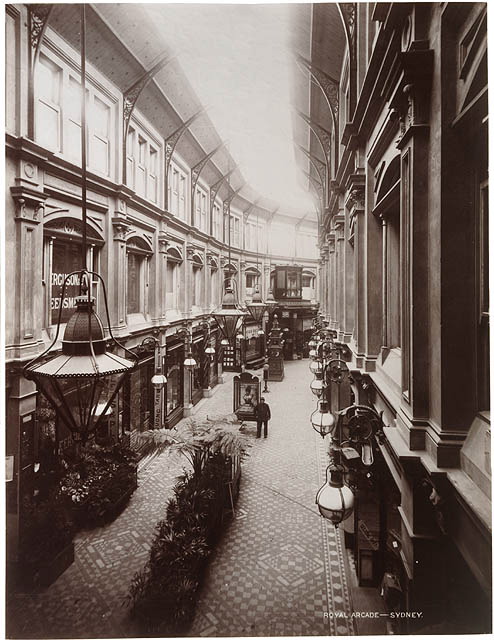
Luca Antara, the book, tarries a while in the QVB, because, when I first came to Sydney, that's where the Public Library was. I was interested in telling a brief version of its history but as I was in New Zealand when I wrote that section, I got my material on-line. Now, preparing the Notes on Sources, I find that there is a book about the Grand Dame. The Queen Victoria Building 1898-1986, by John Shaw with photos by David Moore (among others), was written at the initiative of architects Stephenson & Turner, who carried out the restoration of the building in the 1980s. Lovely book. One of its glories is the archival photographs, which are not restricted to the building itself but cover many aspects of Sydney's CBD down the years. I was fascinated by the pictures of arcades, most of which were demolished before I came here. The Imperial Arcade, which resembled a theatre set; the Victoria Arcade, with its elliptical glass dome; the Royal Arcade with its Roman and Florentine echoes. Only the Strand Arcade now remains, along with the QVB itself which, although it is a free standing building, has many affinities with arcade buildings, for example, its glazed barrel vault roof.

I can't remember now where we'd been - perhaps to a concert or a gig - I do recall one night, late, wandering with my then wife into the newly restored QVB, which was wide open, brightly lit and vastly empty; this was before the shops had been tenanted or opened. There was distant music coming from the upper levels. We walked into each other's arms and waltzed together along the tiled floor of the promenade known as the Avenue. This floor slopes, there's a slight hill running down Market Street towards George Street, probably the old bank of the Tank Stream, and the makers of the building followed that fall. I'm no longer sure either if it was the same night or another - probably the same - that, climbing the stairs we found, on the top-most level, a function or celebration of some kind going on. Passing across the floor we encountered Barry Humphries, so shickered he could not stand up, being escorted, like an ocean liner by tugboats, by two gorgeous young women from one revelry to another. Or perhaps from revelry to bathroom.
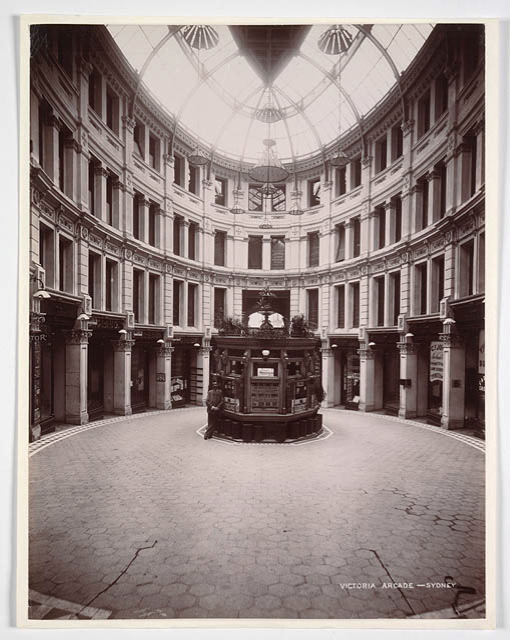
After finishing the book I went and had another look at the QVB, and at the Strand Arcade. Beautiful structures, beautifully restored (Stephenson & Turner did the Strand as well), yet I couldn't help feeling a slight pang of disappointment. Why? I think it's just the dullness of the use they are put to, at least from my point of view. I can remember being absolutely fascinated by the arcades in Auckland in the 1970s, because of the strange variety of shops, businesses and other organisations you found there: erotica, philately, obscure foreign friendship societies, fortune tellers, dance academies and who knows what else. Whereas now what you find is the relentless shininess of contemporary consumer culture. Many wonderful things are there which you can buy if you want, but something else is lacking, perhaps aura, perhaps grime, perhaps a whiff of the disreputable. The QVB replaced the George Street Markets and was built as a market itself. In its early days it attracted palmists and mind-readers along with teachers of music, art and dance. Now mostly what you find are handbags, hand lotions, hand made chocolates. It'd be an awful confession to say that I preferred the QVB derelict and that isn't quite what I mean. I just wish there was less shininess, more texture, some fluid and chaotic tactility there.
Monday, March 13, 2006
RuneScape
Had a good time with my kids this weekend. Or, should I say, they had a good time with me? Partly it was because Jesse's friend Monty came over Saturday night for a sleepover. Kids like being in a pack, even three is better than two. At one point we went over to the local park for an hour or so. It was early evening; tennis on the courts, skate-boarders and bike riders on the skate-board rink, smaller kids on the equipment and the littlies in the fenced off playground; a soccer game featuring, I noticed, two of the guys from the local liquor shop. At one point Liamh, who's obsessed with them, found a stash of sticks behind a tree on the far edge of the park and enlisted the other two in a game. I watched it from a bench on the other side, far too far away to hear anything or see detail. They were big, robust looking sticks, thick and long; but the boys seemed to be using them not as weapons but as ... I don't know? Wands? Their movements had an hieratic quality, they held them gesturally and moved them slowly through the air. It looked like a dance and went on for quite a while, quarter of an hour maybe. Then, all of a sudden, they laid them down (behind another tree, for later perhaps) and came tearing back across the park towards me. As we were walking home I asked what they'd been doing. Orrh, said Jesse, We were playing Runescape. He didn't expatiate and I didn't ask. Runescape's huge among the kids and it seems like a different sort of game from the usual shoot 'em up, bang 'em down. My boys don't play it here much because it requires a PC for its full range to be available and I'm on a Mac; when they do I'm impressed by the contemplative air that comes over the flat. One day this weekend I watched them build a canoe and sail it down a river. Another time, I recall Jesse telling me he knew how to fletch arrows. He described the process in great detail and then allowed that, yes, they were virtual arrows. This is a game where groups form and play against/with each other; some of these groups are very large and, it goes without saying, they are multinational. I'm intrigued ... but not as intrigued as I was by the stick game I saw across the park the other evening.
Friday, March 10, 2006
Once on Chunuk Bair
Am I getting sentimental in my old age? The other morning, just after I woke up, I felt the need to check some geographical details with respect to the Gallipoli peninsular. I was trying to understand the precise relationship between Lone Pine, Chunuk Bair and the Nek. Also, which were the troops that took the first, and the second, though only briefly, and were slaughtered in their hundreds at the third site. Was it simply the sound of the names in my head, on my tongue, that blurred my eyes, so that I could not read the words on the page? It was strange to lie back on the pillows and feel the tears running down my cheeks - why?
Sunday, March 05, 2006
badman
As anyone who has ventured there knows, Ern Malley Alley is a hall of mirrors, an infinite regression, a world of answers without questions and questions lacking answers. You go there at your peril and if you will be so bold or so foolish, you need allies: a sense of humour, an unimpaired sceptical sense, what Keats called negative capability ... anyway. Something I hadn't quite considered when I entered the labyrinth was that I would be dealing with my father's generation, obvious as that might seem. He was born in 1920, the second of three brothers. Ern Malley was born in 1918, the 14th of March, Einstein's birthday; James McAuley in 1917, Harold Stewart in 1916 ...
Another thing I did not anticipate is that I would find myself wrangling with the ghost of Don Bradman (b. 1908). How did this happen? Well, partly it's simply local history: the boy from Bowral made his first century in Sydney grade cricket just down the road from here, at Petersham Oval (there's a plaque), which means it's at least possible that Ern, who grew up in the area, was there that November day. Partly, too, it's because if you read Australian history between the wars, you simply can't escape the Don. He is ubiquitous. So that, a few weeks ago, I went to the Ashfield library and brought home a couple of books, one of which, written by an Englishman as social history as well as sporting biography, was so good that I read it cover to cover in a matter of days. Now, coincidentally, I've just watched the second instalment of a two part television documentary on ABC, which covers the same ground as the book and even interviews its author. So what have I learned?
Well, it's an emotional minefield. And very personal. My father loved two sports, rugby and cricket. He'd played both, with some skill, in his youth, coached school teams while he was teaching, later on spent a lot of time listening to games on the radio or watching them on television. I inherited these enthusiasms from him and maintained them during his long decline partly so as to have this neutral common ground where we could always go when we talked. Now he's gone I don't know why I keep them up because the actual sporting culture as it has evolved, mostly disgusts me. That's one thing. The second thing is the intimate relationship between Australian life and sporting prowess. Much has been made of the fact that Bradman's prodigious feats as a batsman began during the Great Depression and that for many people living in penury and misery, he became a kind of secular saviour ... this strange contract, between sporting success and the pride of individuals in themselves, is not confined to Australians but they - we - are certainly paragons in its expression. As an expat New Zealander who is an Australian citizen, I express this fanaticism in reverse, taking no pleasure in Australian wins and great delight in their unfortunately rare losses. Weird, huh?
But, Bradman. The great hero of the common man, and a common man himself ... except he wasn't. He was a protestant in a land of Irish Catholics, a teetotaller in a country of drinkers and drunks, he played the piano and listened to classical music, in the evenings after a day's play, instead of celebrating with his mates, he'd go to his room and write letters or read books. And get an early night. He was also a Royalist in a culture that at least fancies itself to be 'naturally' Republican, he earned his living as a stock broker and wasn't above taking financial advantage of circumstances when he could see a way to do so - when, in 1945, his boss in Adelaide informed the Stock Exchange he could no longer meet his commitments, Bradman had taken over the office and hung his shingle out within 36 hours of the declaration, apparently with the consent of the receiver. In some of this, he shows a character not unlike that of my paternal grandfather, who was all of those things: protestant, teetotal, royalist, businessman, devious, a sporting fanatic - and Australian; most of this description also fits the present Australian Prime Minister, John Howard (I don't believe he is teetotal). The other thing the three men - Bradman, my grandfather, Little Johnny - have in common is their ruthlessness.
As we know, sport is a surrogate for war and despite all the waffle about playing the game, you can't really engage in it without a determination to win. Afterwards you may fraternise with your opponents but while the game's on you have to be prepared almost to kill. In our peculiar culture, that analogy with war does extend to business and to politics, but with this difference: the wins and losses are real, there are real victims, real casualties, real deaths. Bradman's extreme ruthlessness as a cricketer, later as Australian captain, was mostly visited upon the English, whom he took great delight in humiliating howsoever and whenever he could; but there was no contradiction with his Royalism or his Empire Loyalism, because it was just a game. For precisely the same reason, sport/war is a very bad analogy for business and politics, but pervasive nevertheless. Watching Little Johnny bask in the approbation of the local version of the great and the good during his ten year anniversary celebrations made me realise that he has a conscience white as the driven snow, as they say, most likely because he's left all that behind on the playing field. Watching the obsequies for Kerry Packer, that superlative sporting man, the other week led to the same conclusion. For these kinds of people, the end does justify the means and the end is, in the end, very simple: to win.
My father set himself against his father and attempted to live an ethical life; it ended in alcoholism, loneliness and despair, with one of his few consolations, the rugby or the cricket on the TV or the radio. This doesn’t mean that he made the wrong choice and nor is it sufficient to ascribe his fate to that choice: of course not, there were a lot of other factors involved, which I can’t go into here. But it was a conscious choice: the poetry he wrote in his youth he abandoned in order to dedicate himself to a form of social action which would make a real difference to peoples’ lives and in this he was remarkably successful; the visits he sometimes got from those he had taught were another of his consolations.
Ern Malley didn’t have to live with the consequences of his dedication to poetry, though both James McAuley and Harold Stewart did. Sometimes I imagine Malley as a kind of Anti-Bradman, feckless where the other was conscientious, ironic rather than sincere, profligate not abstemious, raucous not calm, unsporting, twisted, decadent, sardonic, rude … but of course he wasn’t an Anti-Bradman so much as an Anti-Everything: everything, that is, that could not be fitted into the world view of two gifted yet resentful men, both self-hating, one of whom became a Catholic conservative academic, the other a scholarly Buddhist monk. As for Bradman, he lived to a ripe old age and was, so far as one can tell, kind to his old opponents - but never forgave his enemies. I understand John Howard is a great hater too.
Another thing I did not anticipate is that I would find myself wrangling with the ghost of Don Bradman (b. 1908). How did this happen? Well, partly it's simply local history: the boy from Bowral made his first century in Sydney grade cricket just down the road from here, at Petersham Oval (there's a plaque), which means it's at least possible that Ern, who grew up in the area, was there that November day. Partly, too, it's because if you read Australian history between the wars, you simply can't escape the Don. He is ubiquitous. So that, a few weeks ago, I went to the Ashfield library and brought home a couple of books, one of which, written by an Englishman as social history as well as sporting biography, was so good that I read it cover to cover in a matter of days. Now, coincidentally, I've just watched the second instalment of a two part television documentary on ABC, which covers the same ground as the book and even interviews its author. So what have I learned?
Well, it's an emotional minefield. And very personal. My father loved two sports, rugby and cricket. He'd played both, with some skill, in his youth, coached school teams while he was teaching, later on spent a lot of time listening to games on the radio or watching them on television. I inherited these enthusiasms from him and maintained them during his long decline partly so as to have this neutral common ground where we could always go when we talked. Now he's gone I don't know why I keep them up because the actual sporting culture as it has evolved, mostly disgusts me. That's one thing. The second thing is the intimate relationship between Australian life and sporting prowess. Much has been made of the fact that Bradman's prodigious feats as a batsman began during the Great Depression and that for many people living in penury and misery, he became a kind of secular saviour ... this strange contract, between sporting success and the pride of individuals in themselves, is not confined to Australians but they - we - are certainly paragons in its expression. As an expat New Zealander who is an Australian citizen, I express this fanaticism in reverse, taking no pleasure in Australian wins and great delight in their unfortunately rare losses. Weird, huh?
But, Bradman. The great hero of the common man, and a common man himself ... except he wasn't. He was a protestant in a land of Irish Catholics, a teetotaller in a country of drinkers and drunks, he played the piano and listened to classical music, in the evenings after a day's play, instead of celebrating with his mates, he'd go to his room and write letters or read books. And get an early night. He was also a Royalist in a culture that at least fancies itself to be 'naturally' Republican, he earned his living as a stock broker and wasn't above taking financial advantage of circumstances when he could see a way to do so - when, in 1945, his boss in Adelaide informed the Stock Exchange he could no longer meet his commitments, Bradman had taken over the office and hung his shingle out within 36 hours of the declaration, apparently with the consent of the receiver. In some of this, he shows a character not unlike that of my paternal grandfather, who was all of those things: protestant, teetotal, royalist, businessman, devious, a sporting fanatic - and Australian; most of this description also fits the present Australian Prime Minister, John Howard (I don't believe he is teetotal). The other thing the three men - Bradman, my grandfather, Little Johnny - have in common is their ruthlessness.
As we know, sport is a surrogate for war and despite all the waffle about playing the game, you can't really engage in it without a determination to win. Afterwards you may fraternise with your opponents but while the game's on you have to be prepared almost to kill. In our peculiar culture, that analogy with war does extend to business and to politics, but with this difference: the wins and losses are real, there are real victims, real casualties, real deaths. Bradman's extreme ruthlessness as a cricketer, later as Australian captain, was mostly visited upon the English, whom he took great delight in humiliating howsoever and whenever he could; but there was no contradiction with his Royalism or his Empire Loyalism, because it was just a game. For precisely the same reason, sport/war is a very bad analogy for business and politics, but pervasive nevertheless. Watching Little Johnny bask in the approbation of the local version of the great and the good during his ten year anniversary celebrations made me realise that he has a conscience white as the driven snow, as they say, most likely because he's left all that behind on the playing field. Watching the obsequies for Kerry Packer, that superlative sporting man, the other week led to the same conclusion. For these kinds of people, the end does justify the means and the end is, in the end, very simple: to win.
My father set himself against his father and attempted to live an ethical life; it ended in alcoholism, loneliness and despair, with one of his few consolations, the rugby or the cricket on the TV or the radio. This doesn’t mean that he made the wrong choice and nor is it sufficient to ascribe his fate to that choice: of course not, there were a lot of other factors involved, which I can’t go into here. But it was a conscious choice: the poetry he wrote in his youth he abandoned in order to dedicate himself to a form of social action which would make a real difference to peoples’ lives and in this he was remarkably successful; the visits he sometimes got from those he had taught were another of his consolations.
Ern Malley didn’t have to live with the consequences of his dedication to poetry, though both James McAuley and Harold Stewart did. Sometimes I imagine Malley as a kind of Anti-Bradman, feckless where the other was conscientious, ironic rather than sincere, profligate not abstemious, raucous not calm, unsporting, twisted, decadent, sardonic, rude … but of course he wasn’t an Anti-Bradman so much as an Anti-Everything: everything, that is, that could not be fitted into the world view of two gifted yet resentful men, both self-hating, one of whom became a Catholic conservative academic, the other a scholarly Buddhist monk. As for Bradman, he lived to a ripe old age and was, so far as one can tell, kind to his old opponents - but never forgave his enemies. I understand John Howard is a great hater too.
Wednesday, March 01, 2006
Houses of the Poets
It's never quite clear to me what is to be gained by going to look at houses where known people were born, grew up or at some stage lived, which doesn't mean I don't sometimes do it. At the very least, I suppose, there is subsequently a memory trace where before was either a blank or something imaginary. Which isn't to say the imaginary isn't preferable, only that it will in most cases recede before the real. Anyway ... having learned from Michael Ackland's book Damaged Men the addresses of the houses where James McAuley and Harold Stewart grew up, and realised they are both within a few kilometres of here, I went today to look at them.
52 The Crescent, Homebush, McAuley's home from the mid 1920s until he left home during WW2, is a small brick Victorian villa in a now leafy street running parallel to the main western line just down the road from the Homebush shops. It's shabby and neglected now, it looks like it's rented out, but it was probably far more prepossessing and indeed, straight-laced, when it belonged to the McAuley family. Jim's Dad was a successful real estate agent which raises the question as to why he kept on living in this rather small house in this rather grim suburb with its stockyards and its abbatoir; on the other hand, according to Jim, he was a rather grim man.
Although McAuley remembered the scent of wisteria, there's now a small frangi pani tree outside the window of the bedroom next to the front door, which may have been his: At night he watched the dancing shadows created by the lights of passing trains on his bedroom walls and dreamed of unknown destinations, Ackland says. The most startling presence in the street is an enormous Gallipoli Pine growing behind the house, one of the largest I have seen. McAuley, born in Lakemba in 1917, may have come into the world contemporaneous with this tree and I took its sombre presence as a sign that he still haunts the neighbourhood.
Chowringhee, where Harold Stewart was born in 1916 and where he grew up, is or was at 31 Tavistock Street, Drummoyne: a short, also leafy street, running up hill from Drummoyne Park with its green oval, not far from Five Dock Bay. All three streets crossing Tavistock are now major traffic arteries so the area does not have the quiet gentility it did when Harold lived here. His father, who was in India until his early thirties and spoke fluent Hindustani, was the local health officer.
The house at #31 presented the same drab exterior as did the McAuley residence, though it was clearly a much larger place. However, it seems to have been divided at some point into a makeshift duplex; the name plate, if there ever was one, has disappeared and I did wonder, since the other half of the duplex was #33, if I had the right house. Perhaps the street had been renumbered at some point?
This is what Ackland describes: Tavistock Street was shaded by camphor laurels and small gardens set off the entrances to most of its serried brick houses. The drab exterior of the Stewarts’ home accorded ill with its exotic Indian name ... and its tastefully presented interior. A large rear veranda afforded easy access to a modest oasis of calm, with fernery, fish pond, vines and a spreading apple tree, while Marion (Harold's sister, younger than him by nine years) remembered home-life as characterised by ahimsa, or non-violence of thought and deed.
There was a bullish looking man in a large 4WD parked outside #31 with the talkback radio turned up loud in his cab and he gave me the leery eye when I turned the car around and parked across the road to get a decent look at the house, so I didn't hang around for long. Ackland also writes: ... in the 1920s the future poet could still wander along dusty, unmade roads lined with gumtrees and post-and-rail fences, reminiscent of country towns, and shimmering water was always close at hand.
In contradistinction to the grimness of McAuley's bedroom (ordered and impersonal, its furnishings kept to a minimum with a bed, dresser and bare walls), Harold's served as study, art studio and music room ... the bed, which doubled as a settee when friends called, had a deep blue coverlet shot through with muted gold thread and [the room] contained a large desk, ample library, music stand and gramophone, as well as a small table for displaying art works — making it the prototype of his successive dwellings.
The strongest impression I took away from both houses is perhaps paradoxical: they each in their different way reminded me of the house at 40 Dalmer Street in Croyden, Ern Malley's sister Ethel's house, where the imaginary poet spent his last few imaginary months. This house was, as they say in fact, owned by Harold's sister, the aforementioned Marion ... the other thing I glimpsed, though only in passing, was the uniformity of these lower middle class western Sydney suburbs between the wars, with their rows and rows of near identical houses made of liver coloured brick, their pubs and corner shops, their bare streets where the trees, if they had even yet been planted, had scarcely begun to grow.
52 The Crescent, Homebush, McAuley's home from the mid 1920s until he left home during WW2, is a small brick Victorian villa in a now leafy street running parallel to the main western line just down the road from the Homebush shops. It's shabby and neglected now, it looks like it's rented out, but it was probably far more prepossessing and indeed, straight-laced, when it belonged to the McAuley family. Jim's Dad was a successful real estate agent which raises the question as to why he kept on living in this rather small house in this rather grim suburb with its stockyards and its abbatoir; on the other hand, according to Jim, he was a rather grim man.
Although McAuley remembered the scent of wisteria, there's now a small frangi pani tree outside the window of the bedroom next to the front door, which may have been his: At night he watched the dancing shadows created by the lights of passing trains on his bedroom walls and dreamed of unknown destinations, Ackland says. The most startling presence in the street is an enormous Gallipoli Pine growing behind the house, one of the largest I have seen. McAuley, born in Lakemba in 1917, may have come into the world contemporaneous with this tree and I took its sombre presence as a sign that he still haunts the neighbourhood.
Chowringhee, where Harold Stewart was born in 1916 and where he grew up, is or was at 31 Tavistock Street, Drummoyne: a short, also leafy street, running up hill from Drummoyne Park with its green oval, not far from Five Dock Bay. All three streets crossing Tavistock are now major traffic arteries so the area does not have the quiet gentility it did when Harold lived here. His father, who was in India until his early thirties and spoke fluent Hindustani, was the local health officer.
The house at #31 presented the same drab exterior as did the McAuley residence, though it was clearly a much larger place. However, it seems to have been divided at some point into a makeshift duplex; the name plate, if there ever was one, has disappeared and I did wonder, since the other half of the duplex was #33, if I had the right house. Perhaps the street had been renumbered at some point?
This is what Ackland describes: Tavistock Street was shaded by camphor laurels and small gardens set off the entrances to most of its serried brick houses. The drab exterior of the Stewarts’ home accorded ill with its exotic Indian name ... and its tastefully presented interior. A large rear veranda afforded easy access to a modest oasis of calm, with fernery, fish pond, vines and a spreading apple tree, while Marion (Harold's sister, younger than him by nine years) remembered home-life as characterised by ahimsa, or non-violence of thought and deed.
There was a bullish looking man in a large 4WD parked outside #31 with the talkback radio turned up loud in his cab and he gave me the leery eye when I turned the car around and parked across the road to get a decent look at the house, so I didn't hang around for long. Ackland also writes: ... in the 1920s the future poet could still wander along dusty, unmade roads lined with gumtrees and post-and-rail fences, reminiscent of country towns, and shimmering water was always close at hand.
In contradistinction to the grimness of McAuley's bedroom (ordered and impersonal, its furnishings kept to a minimum with a bed, dresser and bare walls), Harold's served as study, art studio and music room ... the bed, which doubled as a settee when friends called, had a deep blue coverlet shot through with muted gold thread and [the room] contained a large desk, ample library, music stand and gramophone, as well as a small table for displaying art works — making it the prototype of his successive dwellings.
The strongest impression I took away from both houses is perhaps paradoxical: they each in their different way reminded me of the house at 40 Dalmer Street in Croyden, Ern Malley's sister Ethel's house, where the imaginary poet spent his last few imaginary months. This house was, as they say in fact, owned by Harold's sister, the aforementioned Marion ... the other thing I glimpsed, though only in passing, was the uniformity of these lower middle class western Sydney suburbs between the wars, with their rows and rows of near identical houses made of liver coloured brick, their pubs and corner shops, their bare streets where the trees, if they had even yet been planted, had scarcely begun to grow.
Sunday, February 26, 2006
This site is allegedly a year old today tho', not really, because the first few posts appeared on the sister site & were moved over here later ... b-but it is a year since I got my taxi licence (for the third time!) & thus time to renew it again. Because I'm not driving at the moment that can be done in a fairly leisurely manner, still costs about 500 bucks however, which I don't like paying, specially because I don't really ever want to drive a cab again ... on the other hand, common sense tells me that, things being as they are, precarious, I can't really afford not to (renew my licence I mean). Will probably run out of money not long after this financial year ends (June 30) &, unless something else comes along, how else am I going to make the rent? pay for the kids? feed my habit(s)? ... ah, yes, sometimes I really do wonder how much of this money anxiety I feel is constitutional, how much circumstantial? Would I still feel insecure on 500 grand a year? Some of my happiest times have been when I've had nothing blah blah blah ...
Sunday, February 19, 2006
QE2
Last week two nights in a row, at the same hour, I went to the Dendy Cinema at Circular Quay to see a film. The first, the premier of a short I'd been invited to because I'd been speaking with the producer about another matter; the second, the opening of the IndiVision Screenings for this year - I was a participant in the IndiVision Lab last year. Neither film was quite satisfactory but that's not what I'm here to say.
I always prefer being early to the movies so I caught the train about 5.15 and was at the Quay by 5.45 for a 6.15 screening. There I was, ambling along, in no hurry, intending to stop in at an art shop where you can reliably see lithos by the likes of Chagall and Miro and Dali and Bonnard, when I look up and see this:
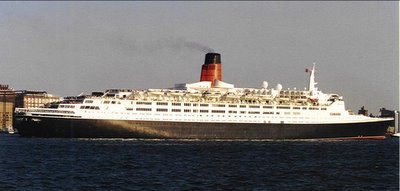
She was moored in West Circular Quay and took up the whole length of harbour on that side, seeming as long if not longer than the bridge, which kind of grew out of her bow. A few lights on, a few idle figures lounging on her decks taking the evening air - they were all David Niven types in white cravats to me, smoking Sobranes - while hanging below her funnel, bizarrely, was a hand written banner saying DO NOT APPROACH CLOSER THAN FIFTY METRES. For terrorists, I guess.
Big old ocean liners always make me think of Fellini's Amarcord, the night scene where the characters row or wade out into the water to see one passing by, like a space ship from some wonderful, perhaps alien civilization whose planet you might one day be lucky enough to visit.
Thursday was hot and then about four the thunderheads rolled in, with a spattering of big fat drops which, by the time I went to catch the train, had turned to steady though not hard rain. The train must have travelled with the cloud because it was raining as well in the City, which had been clear when I left - I can see it from my balcony. I don't mind getting a bit wet, I was enjoying it and anyway, there's a covered walkway from the Quay to the Toaster and the Opera House and the QE2 was still there, looking more like this:
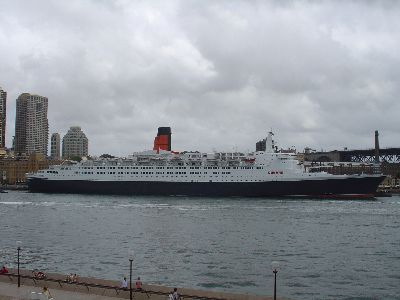
though rather more beautiful in the after storm light. I knew by now that she was departing for Melbourne that night and could already see a thin thread of diesel smoke drifting from her funnel. I was hoping that after the movie was over we might be lucky enough to see her steam out - that would have been something. The film, from Israel, was an inconsequential tale about a unit of girl soldiers patrolling Jerusalem which somehow managed to be trivial and claustrophobic at the same time and, instead of ending, just stopped. The last shot was interminable, two girls on one motorcycle riding through the city with, for some reason I will never know, the word KIWI written on each of their helmets.
It was dark by now, we stood around in a roped off enclosure in a bar area under the Opera House as canapes and wine waiters circled and networks got worked. I was with a director friend and she was with an actor friend and none of us could raise much enthusiasm for working the nets so, just as they served trays of boxed stir-fried beef noodles, we left and ate leaning over the rails looking at that fabulous apparition which, while it was smoking more than it had been, did not look like leaving before we ourselves wandered off into the night.
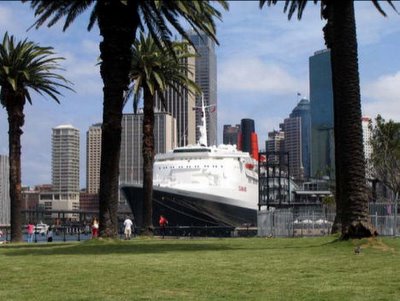
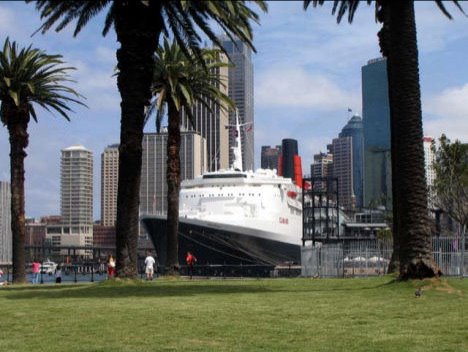
So she's gone now but, if I'd got around to the other side of the Quay in daylight, I might have seen something like this:
I always prefer being early to the movies so I caught the train about 5.15 and was at the Quay by 5.45 for a 6.15 screening. There I was, ambling along, in no hurry, intending to stop in at an art shop where you can reliably see lithos by the likes of Chagall and Miro and Dali and Bonnard, when I look up and see this:

She was moored in West Circular Quay and took up the whole length of harbour on that side, seeming as long if not longer than the bridge, which kind of grew out of her bow. A few lights on, a few idle figures lounging on her decks taking the evening air - they were all David Niven types in white cravats to me, smoking Sobranes - while hanging below her funnel, bizarrely, was a hand written banner saying DO NOT APPROACH CLOSER THAN FIFTY METRES. For terrorists, I guess.
Big old ocean liners always make me think of Fellini's Amarcord, the night scene where the characters row or wade out into the water to see one passing by, like a space ship from some wonderful, perhaps alien civilization whose planet you might one day be lucky enough to visit.
Thursday was hot and then about four the thunderheads rolled in, with a spattering of big fat drops which, by the time I went to catch the train, had turned to steady though not hard rain. The train must have travelled with the cloud because it was raining as well in the City, which had been clear when I left - I can see it from my balcony. I don't mind getting a bit wet, I was enjoying it and anyway, there's a covered walkway from the Quay to the Toaster and the Opera House and the QE2 was still there, looking more like this:

though rather more beautiful in the after storm light. I knew by now that she was departing for Melbourne that night and could already see a thin thread of diesel smoke drifting from her funnel. I was hoping that after the movie was over we might be lucky enough to see her steam out - that would have been something. The film, from Israel, was an inconsequential tale about a unit of girl soldiers patrolling Jerusalem which somehow managed to be trivial and claustrophobic at the same time and, instead of ending, just stopped. The last shot was interminable, two girls on one motorcycle riding through the city with, for some reason I will never know, the word KIWI written on each of their helmets.
It was dark by now, we stood around in a roped off enclosure in a bar area under the Opera House as canapes and wine waiters circled and networks got worked. I was with a director friend and she was with an actor friend and none of us could raise much enthusiasm for working the nets so, just as they served trays of boxed stir-fried beef noodles, we left and ate leaning over the rails looking at that fabulous apparition which, while it was smoking more than it had been, did not look like leaving before we ourselves wandered off into the night.
So she's gone now but, if I'd got around to the other side of the Quay in daylight, I might have seen something like this:
Tuesday, February 07, 2006
Rowe Street

For a big city, a world city as it likes to think itself, Sydney does not have a very good Public Library. This probably reflects the way the municipality is divided up, the Sydney City Council has jurisdiction only over the CBD proper, the adjoining inner city suburbs are administered by other councils; most of the suburban libraries are rather better, if not bigger, than the Central one. I haven't bothered rejoining since I came back here to live a year ago and in fact didn't even know where it was any more, until yesterday.
I was going to see an exhibition called Memory Lane : Recollecting Rowe Street. Rowe Street was a short narrow street running between Castlereagh and Pitt Streets, just south of Martin Place in the City. It was like an Arcade without a roof and featured shops you didn't find in other parts of town. At one end was the grand Australia Hotel, at the other, the Millions Club (dedicated to population growth); in between you could (in the 1950s and 60s) buy chic hats and dresses, espresso, avant-garde pictures, banned books and modern furnishings. It had been that way, a little piece of Bohemia, at least since the start of the 20th century, when the former literary editor of the Bulletin, A. G. Stephens, and artists Lionel Lindsay and Antonio Datillo-Rubbo rented garret studios on the street.
The exhibition, on the first floor at the recently restored Customs House at Circular Quay, didn't amount to much : three glass cases of displays of wares from those chic and arty shops plus a dozen or so photographs made over into large wall panels. Interesting enough but it wasn't quite what I was expecting. The New Customs House is open plan and there was a lot of conspicuously leisurely lounging around going on, which I found distracting I guess. Never mind.
It was as I was leaving that wing where the exhibition was that I saw a high tech, bright red counter at one end of the floor and realised it was a library I was in ... the Sydney Public Library, made over to look as much as possible like a bookshop - one with hardly any books it it. Fiction A - L seemed all that there was; and the copy of The Situationist City lying casually on a table nearby was asking to be - not stolen, picked up and taken away. I resisted that particular temptation and went up to the next floor to explore, looking for the rest of the books.
They were there, on Floor Two, and seemed somewhat rehabilitated from the sad and tatty collection that used to be housed in an office building behind the Town Hall, and before that in a room in the otherwise derelict Queen Victoria Building. I inquired about re-joining and was relieved to learn my name was no longer on the database - there had been some anomalies in my borrowing behaviour in earlier years - but startled to learn that there is now a joining fee of $11.50. The help was either ignorant or terminally rude, I couldn't decide which. Well, I will join, I guess, sometime ...
Getting back to Rowe Street, most of it was demolished in the early 1970s to make way for the MLC Centre, about which the less said, probably the better. The bit they didn't destroy still exists, a numb and bland service lane running behind the Commonwealth Bank Building to the back of the MLC and the Theatre Royal. I did like the epigraph for the show, from Baudelaire : The form of a city changes more quickly, alas, than the heart of a mortal.
Thursday, February 02, 2006
Two 14 year old girls have been arrested for this murder. Cousins. They were detained by Transit Police for fare evasion at Strathfield Station. They apparently had done another robbery (with a knife?) and attempted several more between the murder of the cabbie and the incident at Strath. A witness to the pre or post of the murder said one of them was of Polynesian appearance. That is congruent with the TV images, although everyone (= family) had their heads covered, getting in and out of cars. Can see I'm going to have to stick with this story.
Elias Kopti, a general manager at South Western Cabs where Mr Hormozi worked, said Mr Hormozi was a "risk taker" who would take on passengers other drivers avoided. He said Mr Hormozi preferred to work the night shift and was well known for accepting any available passenger. "He never chooses his fare - he'll pick anyone up," Mr Kopti said. "He was a risk taker. He will pick up all the junkies." Mr Kopti said this was despite Mr Hormozi being robbed at least 10 times, three at gunpoint, during about 20 years of taxi driving.
Sydney Morning Herald, 2.2.06
Sydney Morning Herald, 2.2.06
Tuesday, January 31, 2006
Youbert Hormozi
Today I set in process the things I need to do to renew my taxi driver licence. It will take a few months and cost half a grand but I feel I must keep that option alive, even though I've not had to earn money driving for the last six months and won't have to for the next six either. Was disconcerting to turn on ABC news tonight and see/hear the top story was about a disabled cabbie beaten to death last night at Canley Vale in the south west of the City. He seems to have been an unlucky man, having been in trouble several times before - we don't know what it is that makes some people vulnerable to this kind of violence while others escape the dread consequences of being out and about in the big shitty late at night. The boss of his network said: The guy is not really healthy because he had a stroke on his left side ... he was a lonely man actually, he was living on his own, and he was a very simple man. He was robbed at gunpoint a few times and he was still going on working because he had nothing to do but drive cabs. His name was Youbert Hormozi. He was 53 years old, Iranian, separated, with two children. He lived in Summer Hill.
Monday, January 30, 2006
wondie
After the Chinese New Year party on Sunday me and Liamh drove to Strathfield to catch the train to Woy Woy. On the platform a madman in a stained suit with missing teeth thrust his face right up to mine enunciating soundless words accompanied with florid incomprehensible gestures. When we got on the train, Liamh was still clutching in his hand the red envelope he had been given at the party, with a golden ship on the outside and a gift of money within. On the two seats opposite were a young man and a young woman; he, thin and dark with a narrow beard running from the centre of his bottom lip to his chin, cried out when he saw us: That's one of those lucky envelopes, isn't it? Did you get it at Darling Harbour? No, I said, we've been at a friend's place ... He was exuberant and charming and the conversation between us continued intermittently for the rest of the hour's journey to Woy Woy. Sometimes his girlfriend wanted a cuddle, sometimes they conversed together in low voices, sometimes he stared out the window; most of the rest of the time we talked.
He lived at the top of the ridge above the quarry at Wondabyne, in a camp where he had a tent, a fireplace and a stretch of open ground that he cleared himself in the Brisbane Water National Park. The tent was recent, he'd inherited from someone who had, he said, gone down the river with a hole in the back of his head; before that, he'd lived in a cave where quolls ran over his body at night. Wondabyne is just a trainstop on the Newcastle line where it winds up the western shore of a long inlet off the Hawkesbury River called Mullet Creek. No roads go to Wondabyne, there are no shops or public buildings of any kind, just the sandstone quarry and a few dwellings, most of them on the other side of the water and accessible only by boat. This guy had been there six months, since last August, waiting until a house came up, though he never said exactly what that meant.
His routine was, to get up every morning and come down the hill to the station and catch a train into town. He'd spend the day in the city - doing what, he never said, beyond mentioning that he asked people for money and when he had enough, ten dollars, he'd use that to get a feed - then catch another train home. That morning he'd been late and had run down the hill in his boxer shorts carrying his clothes in his hands ... until brought up short by a brown snake, one of the most poisonous reptiles in the world. This one, he said, didn't want to move, not even when he poked a stick at it, so he'd had to wait. It was too early to go home today - Sunday, 5.30 or thereabouts - so they were going up to Woy, to a mate's place, and would go back to Wondie later. He'd light a fire, to keep the dogs and bad spirits away, and be fast asleep by ten.
Climbing up to the top of the ridge in that country isn't easy. I haven't been in the bush above Mullet Creek but I've wandered all over the Hope Range, on the northern bank of the Hawkesbury just east of there, and it's the same kind of terrain. Basically all those ranges consist of three massive tiers of sandstone, like three giant steps. It's generally impossible to go straight up, you have to go along a diagonal and even then there's a lot of scrambling over crumbly outcrops to do. This guy reckoned he could make the four kilometre climb in about forty minutes in the dark, using the flashlight on his mobile phone for guidance; he said he could come down, like this morning, snakes permitting, in eight minutes.
We talked about the fires that burned through a lot of that country on New Years Day, reaching the ridge next to the one he's on before the change came through; about the wild dogs that haunt the National Park; the varieties of snake, both venomous and not, you find up there; other wild life, like the extremely annoying brush turkey and the sweet and affecting Echidna, a monotreme like the playpus, covered in spines ... he has a cross bow, with a licence, with which he once shot a Big Red, that he butchered and gave to his mates in Woy for their dogs: dogs love kangaroo, he said. I was left unsure if he also has a gun, because when I asked him he said he didn't have a licence for one and left it at that.
His only problem was with the old bloke who lives in the house next to the quarry, who wants to move him on. He said: the only thing that'd move me on is if he killed me ... and ... he's not going to do that, I said. Earlier I'd heard him telling his girlfriend that because he was half Aborigine the land was half his anyway, that's why he felt he had a right to live in and off it. Just before we entered the last tunnel before Woy he pointed out the deep green pool at the very tip of Mullet Creek which some old white guy had shown him, where you could fish for mullet and blackfish and bream and always come back with something. Ate so much fish I'm sick of it, he said as the train flashed out of the light and he turned his attention back to his dark and silent girlfriend.
He lived at the top of the ridge above the quarry at Wondabyne, in a camp where he had a tent, a fireplace and a stretch of open ground that he cleared himself in the Brisbane Water National Park. The tent was recent, he'd inherited from someone who had, he said, gone down the river with a hole in the back of his head; before that, he'd lived in a cave where quolls ran over his body at night. Wondabyne is just a trainstop on the Newcastle line where it winds up the western shore of a long inlet off the Hawkesbury River called Mullet Creek. No roads go to Wondabyne, there are no shops or public buildings of any kind, just the sandstone quarry and a few dwellings, most of them on the other side of the water and accessible only by boat. This guy had been there six months, since last August, waiting until a house came up, though he never said exactly what that meant.
His routine was, to get up every morning and come down the hill to the station and catch a train into town. He'd spend the day in the city - doing what, he never said, beyond mentioning that he asked people for money and when he had enough, ten dollars, he'd use that to get a feed - then catch another train home. That morning he'd been late and had run down the hill in his boxer shorts carrying his clothes in his hands ... until brought up short by a brown snake, one of the most poisonous reptiles in the world. This one, he said, didn't want to move, not even when he poked a stick at it, so he'd had to wait. It was too early to go home today - Sunday, 5.30 or thereabouts - so they were going up to Woy, to a mate's place, and would go back to Wondie later. He'd light a fire, to keep the dogs and bad spirits away, and be fast asleep by ten.
Climbing up to the top of the ridge in that country isn't easy. I haven't been in the bush above Mullet Creek but I've wandered all over the Hope Range, on the northern bank of the Hawkesbury just east of there, and it's the same kind of terrain. Basically all those ranges consist of three massive tiers of sandstone, like three giant steps. It's generally impossible to go straight up, you have to go along a diagonal and even then there's a lot of scrambling over crumbly outcrops to do. This guy reckoned he could make the four kilometre climb in about forty minutes in the dark, using the flashlight on his mobile phone for guidance; he said he could come down, like this morning, snakes permitting, in eight minutes.
We talked about the fires that burned through a lot of that country on New Years Day, reaching the ridge next to the one he's on before the change came through; about the wild dogs that haunt the National Park; the varieties of snake, both venomous and not, you find up there; other wild life, like the extremely annoying brush turkey and the sweet and affecting Echidna, a monotreme like the playpus, covered in spines ... he has a cross bow, with a licence, with which he once shot a Big Red, that he butchered and gave to his mates in Woy for their dogs: dogs love kangaroo, he said. I was left unsure if he also has a gun, because when I asked him he said he didn't have a licence for one and left it at that.
His only problem was with the old bloke who lives in the house next to the quarry, who wants to move him on. He said: the only thing that'd move me on is if he killed me ... and ... he's not going to do that, I said. Earlier I'd heard him telling his girlfriend that because he was half Aborigine the land was half his anyway, that's why he felt he had a right to live in and off it. Just before we entered the last tunnel before Woy he pointed out the deep green pool at the very tip of Mullet Creek which some old white guy had shown him, where you could fish for mullet and blackfish and bream and always come back with something. Ate so much fish I'm sick of it, he said as the train flashed out of the light and he turned his attention back to his dark and silent girlfriend.
Thursday, January 19, 2006
The Marco Polo Motel
The new screenplay I'm about to start drafting opens in a room at the Marco Polo motel, a real place just a few blocks from here on Parramatta Road. I chose it because of the name, of course, but until yesterday had never actually been there. I walked over in the misty afternoon rain, weather I find so much pleasanter than the dry heat we were having in the last days of 2005. The motel is big, oblong, set back slightly from the road, four or five storeys high, built, as some prisons are, around a central courtyard which is also a carpark. It's made out of brick, not quite blond, not red either, some umber in between colour. The office is on the right just as you go in. There was an overweight person sitting on a bench outside whom I took to be a woman because of the size of (her) breasts; only later did I realise he was a bloke and they were man-breasts. Walking into the office was like walking into a John Waters movie. Tiny, it was, and full of people. The first one I saw was a woman straight out of the early 1960s: stark white pancake make-up, inches thick, black bouffant hair so lacquered it looked like one of those plastic Beatles wigs, black slacks, slip-on shoes: a classic Widgie look. She smiled at me and I saw with a shock that she was about seventy years old. There was a child, whom I never quite saw, and then another woman swam into view, with the same make-up, the same hair, the same black slacks and slip-ons. Except she was twenty or thirty years younger. There was also a big bloke with a piece of carved greenstone round his neck, working at a computer and a dapper older gent with a sly insinuating smile which was the result, I learned when I spoke to him, of oddly fitted false teeth. All of these people were swirling around the tiny space, all talking at once; and then suddenly the room cleared and I was left with the younger of the two widgies. I explained that I was thinking of booking a room for friends coming to stay from London and she gave me two electronic keys to view a couple of rooms. It always shocks me, when I haven't been in one for a while, how small and mean motel rooms are. These were umber brick on the inside too, cell-like, with the bare minimum of space, the tiny bathroom, the double bed you have to edge around to get to the window, the garish bedspread, the ubiquitous TV ... out the window was a desolate view of the back yard of a business where rubber dinghies and aluminium runabouts called Tinnies were made. There was nothing to look at, nothing to see, and I felt disconsolate, trying to fit the activities I had imagined for that first scene into such a miniscule place ... back to Reception I went. There, the little bloke with the false teeth was behind the desk and the big bloke with the pounamu was still hanging round the computer. We got talking ... they were all New Zealanders: the guy with the false teeth was married to the elder Widgie, the younger was their daughter; the big bloke was a guest, over from Hokitika. We talked about the South Island, because Teeth was originally from way down that way, from Riverton, west of Invercargill. Well, it was pleasant enough and I was soon on my way, back through the rainy streets ... there's no way I can use the actual location for the motel room scene, although the carpark is interesting, but my dilemma now is, can I use the name? If I hadn't have gone in there I'd have no qualms but now, having met the owners, having looked a little way into their lives, I feel implicated, I feel unsure ... I don't know ...
Saturday, January 14, 2006
The Rio
On the corner of this and Smith Street is a Medical Centre, owned by someone my friend M calls the Little Mogul. He's a Portuguese who also owns and operates the pharmacy in Lackey Street, above which M and her partner J live. He also owns a fair amount of other real estate in Summer Hill. Above the Medical Centre is a pathologist's office. Next door, is Francois's International Hair Salon. Francoise, who surely is not French, parks his car, a silver Holden Astra, at the back of my building. He's a big, gloomy man who looks like he comes from somewhere in the eastern Mediterranean. Next door to his establishment is the Rio, a milk bar. Next door to that there's a bespoke tailor, a cafe - Muse - with a photographer's upstairs, Ellen's (trissy) Interiors and Flowers, a mysterious, always shuttered office which purports to belong to a courier business, then an art gallery that shows oddly retro art, the kind of thing I used to see in Art Society exhibitions in Wellington, New Zealand, in the 1970s, when it was already old-fashioned. (This is a real connection, since one of those 1970s Wellington artists, Shay Docking, has been exhibited here in Summer Hill.) Then a plumber, a garage, a laundry (Nice & Clean, it's called, run by a Vietnamese couple with two young children; I get my washing done there) and finally an orthodontist that advertises mouthguards in any colour you choose. The first two buildings, which include in their frontages all the businesses mentioned as far as the plumbers but excluding the Medical Centre, are old (1893) two storey brick constructions, with residential apartments upstairs. I never see anyone coming or going from these residences, nor have I ever seen anyone on the balconies or at the windows of what look like spacious and probably quite elegant apartments. With one exception - the Old Man who runs The Rio.
I don't know his name. I've never spoken to him. M told me he's from Eastern Europe, probably the Balkans, probably from what used to be called the former Yugoslavia. White-haired, slow-moving, intent, I see him sometimes moving round his shop when I pass by. The Rio is a classic 1950s milk bar, not the kind with tables to sit at, the kind where you used to buy your sweets and drinks, your milk-shakes and ice-creams, over the counter and then go somewhere else to consume them. It's painted blue and white on the outside, the paint is old and tacky, the signage ancient. Sweets, Smokes it says. In the window, cut out pictures of novelty ice creams pasted onto a piece of styrofoam. Some tattered silver tinsel frames half the glass. An Australian flag in one corner. There are coloured stars stuck here and there. Inside, large bottles of soft drink are placed at intervals along the shelves. The shop, which is always half-dark, has a high counter along one side, and on the shelves behind it, more wares are placed at careful intervals. A step leads up to the door that goes into the room behind the shop. The Rio opens regularly each morning except Sunday, and stays open until the early evening. It is usually empty of both customers and owner. In fact, apart from the owner, I have never seen anyone in there at all.
I've only been into the shop once myself. It was last summer. I had my sons with me and two colleagues were visiting to talk about a screenplay. One of them had her two children, older than mine, with her. So there were seven of us, three adults, four children, going to get ice creams. A bell rang as we entered the darkened shop. We stood at the counter, waiting. Nothing happened. No-one came to serve us, there was no sound from the back room, no movement. We stood. Waiting. It was as if we had stepped into some other time, perhaps a January afternoon in 1958. It was endless. Nothing kept on happening. Eventually, we left and went across the road to the shop on the other corner, a mixed business run by a Chinese couple, Tom and Tina, and bought our ice creams there.
J, who has lived in Summer Hill for longer than I have, says the Old Man buys his supplies in bulk from the local Franklin's supermarket. He is of the opinion that the Rio is not really a shop at all, but an art installation. That makes sense from one point of view, but is it the point of view of the Old Man? No-one knows. M has another story about him. She observed, one Christmas morning a few years ago, a large group of people of all ages crowding into the shop and then upstairs where the Old Man lives by himself. They were his extended family. The sound of celebrations continued for most of the day. He takes such care of his business, eccentric as it is. He works hard at it, if by work we understand the attentiveness that he surely gives it. The time we stood waiting for the ice creams he had decided not to sell to us, I never for a moment thought that he did not know we were there. I could feel his presence in the back room, monitoring us, waiting for us to go. That I haven't gone in there again is, I think, out of respect. I think that's why none of the locals go in there. Yet the Rio is always open.
I don't know his name. I've never spoken to him. M told me he's from Eastern Europe, probably the Balkans, probably from what used to be called the former Yugoslavia. White-haired, slow-moving, intent, I see him sometimes moving round his shop when I pass by. The Rio is a classic 1950s milk bar, not the kind with tables to sit at, the kind where you used to buy your sweets and drinks, your milk-shakes and ice-creams, over the counter and then go somewhere else to consume them. It's painted blue and white on the outside, the paint is old and tacky, the signage ancient. Sweets, Smokes it says. In the window, cut out pictures of novelty ice creams pasted onto a piece of styrofoam. Some tattered silver tinsel frames half the glass. An Australian flag in one corner. There are coloured stars stuck here and there. Inside, large bottles of soft drink are placed at intervals along the shelves. The shop, which is always half-dark, has a high counter along one side, and on the shelves behind it, more wares are placed at careful intervals. A step leads up to the door that goes into the room behind the shop. The Rio opens regularly each morning except Sunday, and stays open until the early evening. It is usually empty of both customers and owner. In fact, apart from the owner, I have never seen anyone in there at all.
I've only been into the shop once myself. It was last summer. I had my sons with me and two colleagues were visiting to talk about a screenplay. One of them had her two children, older than mine, with her. So there were seven of us, three adults, four children, going to get ice creams. A bell rang as we entered the darkened shop. We stood at the counter, waiting. Nothing happened. No-one came to serve us, there was no sound from the back room, no movement. We stood. Waiting. It was as if we had stepped into some other time, perhaps a January afternoon in 1958. It was endless. Nothing kept on happening. Eventually, we left and went across the road to the shop on the other corner, a mixed business run by a Chinese couple, Tom and Tina, and bought our ice creams there.
J, who has lived in Summer Hill for longer than I have, says the Old Man buys his supplies in bulk from the local Franklin's supermarket. He is of the opinion that the Rio is not really a shop at all, but an art installation. That makes sense from one point of view, but is it the point of view of the Old Man? No-one knows. M has another story about him. She observed, one Christmas morning a few years ago, a large group of people of all ages crowding into the shop and then upstairs where the Old Man lives by himself. They were his extended family. The sound of celebrations continued for most of the day. He takes such care of his business, eccentric as it is. He works hard at it, if by work we understand the attentiveness that he surely gives it. The time we stood waiting for the ice creams he had decided not to sell to us, I never for a moment thought that he did not know we were there. I could feel his presence in the back room, monitoring us, waiting for us to go. That I haven't gone in there again is, I think, out of respect. I think that's why none of the locals go in there. Yet the Rio is always open.
Friday, January 06, 2006
Iron Cove
Christmas Day, we (my sister, her daughter, my two sons, me) had a picnic in Callen Park, which is a former 19th century estate re-invented as an insane asylum and now uneasily poised between three functions: the rump of a psychiatric hospital, housing mainly dementia patients, in ugly mid-20th century buildings; an Art College in the beautiful old sandstone edifice of the original asylum; and public land, used mainly by exercisers and their dogs. The NSW Writers Centre is also to be found there, an adjunct to the Art College.
We sat under an old elm tree at the edge of a playing field with an arm of the sea across the open grass arena. There were a few other picnickers around, and, behind us, in the nearest building, we could hear a Christmas party going on, with table tennis being played by kids on a veranda. When I went over there with my elder boy to find a bathroom, these people turned out to be a large extended family of Spaniards, some of whose members were perhaps employed as nurses in the institution.
It was hot and dry and, after lunch, I thought we might perhaps go for a swim. Me and Jesse and Liamh ran over the spiky grass, jumped a ditch, crossed the road and then went under trees down to the water's edge. There's a low sea wall running all along the eastern shore of Iron Cove. We took off our shirts and climbed down using the gaps between the sandstone blocks as foot and hand holds. So far so good. But the sea bottom was rocky and uneven and almost every rock encrusted with oyster shells, some live, others broken open and razor sharp.
I carried Liamh out, trying to find a path that Jesse could follow into the deeper water but somehow we both got cut: me with a series of parallel grazes along the top of my left foot just back of the big toe, he with a short deep slice right in the meat at the head of the same toe on his right foot. As we all three drifted out into the bay, Jesse was cross, blaming me for his injury. It wasn't that serious, more bantering, as we decided to swim, not for the island in the middle of the Cove, but to a point east of where we were.
Then he said (dog-paddling and spluttering): Unlike you, I know my purpose in life, and I value it.
Wha ... ? I was silenced. What the hell did that mean? He's just turned nine.
Subsequently we made it to shore and inspected our wounds, which weren't too bad. His reminded him of those devices in which you swipe credit cards and mine, though superficial, produced far more blood and so looked a lot worse than his did. Then an obliging dog came along and both boys started throwing sticks out into the water for it, which it expertly retrieved. I went back to the picnic.
Later I asked Jesse what his purpose in life is?
It's to show my father that I'm a serious person, he said, silencing me again.
We sat under an old elm tree at the edge of a playing field with an arm of the sea across the open grass arena. There were a few other picnickers around, and, behind us, in the nearest building, we could hear a Christmas party going on, with table tennis being played by kids on a veranda. When I went over there with my elder boy to find a bathroom, these people turned out to be a large extended family of Spaniards, some of whose members were perhaps employed as nurses in the institution.
It was hot and dry and, after lunch, I thought we might perhaps go for a swim. Me and Jesse and Liamh ran over the spiky grass, jumped a ditch, crossed the road and then went under trees down to the water's edge. There's a low sea wall running all along the eastern shore of Iron Cove. We took off our shirts and climbed down using the gaps between the sandstone blocks as foot and hand holds. So far so good. But the sea bottom was rocky and uneven and almost every rock encrusted with oyster shells, some live, others broken open and razor sharp.
I carried Liamh out, trying to find a path that Jesse could follow into the deeper water but somehow we both got cut: me with a series of parallel grazes along the top of my left foot just back of the big toe, he with a short deep slice right in the meat at the head of the same toe on his right foot. As we all three drifted out into the bay, Jesse was cross, blaming me for his injury. It wasn't that serious, more bantering, as we decided to swim, not for the island in the middle of the Cove, but to a point east of where we were.
Then he said (dog-paddling and spluttering): Unlike you, I know my purpose in life, and I value it.
Wha ... ? I was silenced. What the hell did that mean? He's just turned nine.
Subsequently we made it to shore and inspected our wounds, which weren't too bad. His reminded him of those devices in which you swipe credit cards and mine, though superficial, produced far more blood and so looked a lot worse than his did. Then an obliging dog came along and both boys started throwing sticks out into the water for it, which it expertly retrieved. I went back to the picnic.
Later I asked Jesse what his purpose in life is?
It's to show my father that I'm a serious person, he said, silencing me again.
Monday, January 02, 2006
hopes
New Year's Eve had the bright idea of walking the kids down to Ashfield Park where, from Ormond Street running parallel on the eastern border, there is an improbable view of Sydney Harbour Bridge, around which the annual fireworks display is concentrated. Having discovered they were not interested in Elvis (there was a re-run of the excellent program Classic Albums on TV), at about 8.40 we gathered up our sparklers and went out. It was a balmy night, heavy with the scent of frangi pani. We crossed Liverpool Road and went up Pembroke Street to the park, to find an amazing scene in progress. Ormond Street was packed with people who'd had the same idea as we did ... and the playground in the park adjoining, the one presided over by Mary Poppins, was packed with children, lithe dark shapes swarming in and over and around the equipment. The crowd was about half Indian and half Chinese, with just a sprinkling of Anglos and one or two Polynesian families. I was surprised by the number of Indians, only because in Ashfield itself I'm less aware of their presence than I am of the Chinese and Polynesians. Anyway, it was a very nice atmos, about as far from the usual boozing, boasting and brawling as can be imagined. The fireworks display itself, at that distance, was as if seen through the wrong end of a telescope: perfect, far away, miniatures. The much vaunted heart on the bridge we could not see at all, or perhaps that went off at midnight, whereas this was the nine o'clock kid's show. After it was over, we lit up our sparklers, giving one to a small Chinese girl of about two who had perhaps, from the way her eyes shone, not seen one before. Then my boys dispersed among the great crowd of other children. Jesse soon linked up with a Polynesian kid called Dillon, then they were joined by a chubby Chinese boy and started roaming round in a gang; while Liamh tagged along when he could, with frequent visits back to home base for reassurance. I was sitting up on a bank on some grass under a tree when a young Indian couple with two kids came and sat down nearby. I'd been watching the father helping his son onto the flying fox, just as I'd been helping mine a few minutes before. He made a greeting, I replied, saying I hoped 2006 would be a good year for him. He laughed. I've been hoping that for ten years now, he said. For me, it's longer than that, I said. That is what we live on, he went on, hopes, and laughed again. His wife, who was plump as he was thin, gathered her sari around her. Their children were small and it was time for them to go. We hung around for another hour or so I guess, before ambling home again. It was such a calm, happy, even joyful, occcasion. Pure joy, like you don't often find.
Subscribe to:
Posts (Atom)