An ibis flies between the towers, looking anxious and out of place as it glides down towards Hyde Park. Two Arab cabbies are doing standing jumps onto the round, fixed metal pillar where you're meant to drop your cigarette butts and your ash. The tubbie Indian from the cab behind mine smiles and says: They happy, they making good money. It's about, oh, 9.15 pm on Tuesday. I think. Could be Wednesday. The Park Street rank in the City. Outside the all night convenience store, in the bright white light, a kid in a green school uniform and an adolescent in torn jeans and T shirt are kicking an undersized soccer ball around. One of the happy Arabs decides to join in. All three of them start kicking the ball with what seems like excessive enthusiasm. It skitters past the legs of passers-by then cannons into the bags of rubbish piled outside McDonalds, spilling coke and hamburger mush onto the footpath. Everybody laughs. I'm thinking about Easy Street. I told the Ambassador there was one in Randwick but, although I've seen the street sign flash by, I've never actually worked out where it is. I crush the last of my Gudang Garam out into the free standing ashtray and get back into the cab to check in my Sydway. Turns out there's two, the other one's in Rozelle. But, this is disappointing, the Randwick one has been eaten by the Prince of Wales Hospital and is now entirely contained within the insititution while the other, in Rozelle, is a service road running between White Bay and the Glebe Island container terminal. Does this mean that nobody actually lives on Easy Street anymore, I'm wondering, as I move my cab up the front of the rank, point as it's called? What a shame. What a fine address to have, either in Randwick or in Rozelle. I see someone in the rearview mirror walking towards me with that oddly determined gait people have when they're going to catch a cab. I can only see the midriff, the tops of the legs, a suit, can't even say right off if it's man or woman. A woman. I have an absurd premonition that she'll ask to be taken to Easy Street. She's Scots and wants to go to Bondi, Francis Street ... that's fine. The kid picks up his greasy soccer ball and looks around for someone else to play with. The ibis will be splashing in the Archibald Fountain by now. Or maybe it's down at the ponds in the Botanical Gardens. The Scottie is pregnant and spends most of the trip on her mobile phone, calling people back home to tell them how Junior's getting on ... s/he's 23 cms long! Also relates in detail some fairly arcane vaginal exercises learned in a class, which her husband refuses to help her with. Insert two fingers and rotate, she hoots. Maybe their kid will live on Easy Street? Now I've got lines from Tom Waits in my head, the song from Small Change called The One That Got Away:
The jigolo's jumpin salty
ain't no trade out on the streets
half past the unlucky
and the hawk's a front-row seat
dressed in full orquestration
stage door johnnys got to pay
and sent him home
talking bout the one that got away
could a been on easy street
could a been a wheel
with irons in the fire
and all them business deals ....
Friday, August 25, 2006
Tuesday, August 22, 2006
rugger buggers
Was idling yesterday afternoon on the rank at Chifley Plaza - where stands an enormous cut-out of Our Ben, shot full of holes as his dream of a light on the hill - or maybe just rusting - when a giant of man came out of the government building that stands there. He had an aura and he was looking around as if he expected to be recognised. Jesus, I thought, it's Phil Kearns! And it was. Unfortunately - or perhaps not - I was one back from point, so he took the cab in front of me. Seconds later, another rugby player, as I thought, climbed into the front seat of mine. An expensive suit, a loud tie, the build of a 2nd five eighth, as they used to be known, rather than a front row forward. Going to Randwick. I asked him which way he wanted to go, because it was rush hour and it pays, literally, to implicate the fare in the chosen route, especially if you're likely to end up stuck in traffic together. He didn't mind. He wasn't au fait with Sydney traffic, he said, since, these days, he lived in Rome. What took you to Rome? I asked. I'm the Australian ambassador there, he said. You don't look old enough, I offered. I'm 52, he replied. What do you say to an ambassador? I wanted to ask him how he got the gig but it seemed too much like effrontery. I wanted to ask him about what a National Party staffer told me last week, that John Howard has a near perfect understanding of the dark underbelly of the Australian psyche. I would have liked to have heard a bit more about the fallout from the Andreotti affair that Peter Robb wrote about in Midnight in Sicily ... we talked of other things. Going up Oxford Street, his palm pilot rang with one of those old fashioned black telephone off at the hook rings. There was a brief discussion about the appointment of an honorary consul somewhere then we went back to talking about this and that. Via the Italian-Australian match at the (soccer) World Cup, we got on to rugby. Yep, I was right, he'd been a player. Knew his stuff. He said the Aussies can't win the (rugby) World Cup next year because their forwards are too young and their backs too old. But that the All Blacks will have to watch out for the French. You only want to play the French once, he said. When he got out in St. Marks Road, there was an odd hesitation between us. I had the sense that there were things he would have liked to ask me as well. But I'll never know what they were. Meanwhile, Phil Kearns was halfway to Mosman, driven by a perhaps oblivious, dour Pakistani with jihad pamphlets in his glove box.

Friday, August 11, 2006
... queens ride in it ...
Twenty Rides & a Love Note
The Curator of Cambodian Art at the Denver Museum, name of Bunker, she looked like a cross between E Annie Proulx and Madelaine Albright and walked with a limp. Art Gallery of NSW to Sydney University.
A Japanese psychologist who specialised in coaching trauma victims giving evidence at criminal trials. A small, extremely alert, birdlike woman who said that Recovered Memory Syndrome does not exist in Japan. University of NSW to the City.
A Czech-born, German speaking, Swiss orthodontist here for a conference. We talked about that variety of homesickness which does not know where home is. City to Darling Harbour.
Two drunken Russian mafioso who'd been at the opening of a boutique in Double Bay and spent the ride to the City discussing recalcitrant employees and amenable strippers.
A Saudi man with three beautiful daughters and one son, whose wife rode on ahead with the boy in another cab, here with his family on holiday: a man of grave courtesy, impeccable manners and the air of a slightly weary prince from another age than ours. City to Glebe.
A mother and daughter, seemingly identical apart from the difference in their ages, 'of Middle Eastern appearance'. I could not tell if they were Arabs or Jews and didn't dare ask. City to Brighton le Sands.
Two Prison Architects from Melbourne who were extremely stressed by the manifold demands of their work. City to the Airport.
A chaotic, Botswana-born IT guy, a White African; we discussed, among other things, marijuana cultivation; he loved Australia but missed his adrenaline fuelled youth, when each day was an improvisation and the stakes life and/or death. He left his keys in the car, but it was a radio job so I remembered the street number and posted them back to him, resisting the temptation to address the envelope: Botswana Bwana. Newtown to Rose Bay.
A large, long-haired man of indeterminate occupation who'd worked for 25 years, on and off, in Chile. Very well informed about both banking and politics but veiled, veiled ... Darlinghurst to Brighton le Sands.
Two half cut Crim/Businessman picked up outside a car yard on Parramatta Road. They were going to a pub in Balmain but, when they realised ‘Jean’ would not be there, changed their minds and went to the Airport instead, along the way hatching nefarious schemes to eliminate rivals and defraud governments.
A Spanish girl with a broken elbow and wrist, sustained when she hit a speed bump while simultaneously riding her pushbike, texting a friend on her mobile phone and attempting to apply balm to her lips. She was delirious with morphine but her friend got her home. RPA Hospital in Camperdown to Marrickville.
Two young smarties on their way to a Christina Aguilera album launch. One of them said he had that very day discussed farting on set with Toni Collette; they other was involved in the buying and selling of pearls from Broome. Glebe to Kings Cross.
Two aging, serious music fans who'd been to hear the Arctic Monkeys at the Enmore and meticulously deconstructed the gig on the cab ride home. St Peters to Kogarah.
Two drunken young men who'd just cleaned up big in an illegal poker game. Though they were het boys, they spoke to each other like lovers as they planned further clean-outs. St Peters to Paddington via Surry Hills.
A garrulous Irish IT guy who spent the first part of the ride abusing the government and the second, after I'd been stopped by the police for speeding, abusing cops. As they wrote out the tickets (there were two, I hadn't filled out my worksheet properly) I found myself explaining the derivation of the word 'fiction'. City to Potts Point.
A woman and a man who'd been dining out together and were now going back to his place for a tryst. She called her husband and children as we drove along, setting him straight on details needed for the Census form and reassuring her kids that she loved them and would see them in the morning. Crows Nest to Bellevue Hill.
A Dancer with a little-girl voice, wrinkled hands, grey thighs, and pink feathers at ankle and wrist. She inadvertently left a perfumed feather behind on the front seat. Surry Hills to Kings Cross.
An obsessed Film Director (is there any other kind?) who meticulously summarised her day's emails for the benefit of her monosyllabic boyfriend, grunting in the back seat; it was about the financial shenanigans of her Producers and the deals they were or were not making with some crooked German financiers. They were looking for a writer but I managed to keep my mouth shut. Darlinghurst to The Rocks.
A couple of stock brokers who never said where they were going: I had to work it out from their conversation with each other; one, an American, rhapsodised about the $330.00 worth of fatty tuna he ate in a sushi bar in Hong Kong; he was making a special detour on his next overseas trip so he could gorge himself there again. City to Bondi.
The Head Caterer at the NSW Houses of Parliament, a big, beautiful Fijian man called Joseph. We spoke about Fiji and he knew every place I’d been there, some of which are very out-of-the-way. Invited me to come and dine at Parliament with him one day, and bring my sons. Macquarie Street to Kogarah.
On Wednesday when I took over from the day driver, an Ecuadorian called Italo, he showed me a love-note a fare had given him and said: This taxi has holes in the floor, but Queens ride in it ...
The Curator of Cambodian Art at the Denver Museum, name of Bunker, she looked like a cross between E Annie Proulx and Madelaine Albright and walked with a limp. Art Gallery of NSW to Sydney University.
A Japanese psychologist who specialised in coaching trauma victims giving evidence at criminal trials. A small, extremely alert, birdlike woman who said that Recovered Memory Syndrome does not exist in Japan. University of NSW to the City.
A Czech-born, German speaking, Swiss orthodontist here for a conference. We talked about that variety of homesickness which does not know where home is. City to Darling Harbour.
Two drunken Russian mafioso who'd been at the opening of a boutique in Double Bay and spent the ride to the City discussing recalcitrant employees and amenable strippers.
A Saudi man with three beautiful daughters and one son, whose wife rode on ahead with the boy in another cab, here with his family on holiday: a man of grave courtesy, impeccable manners and the air of a slightly weary prince from another age than ours. City to Glebe.
A mother and daughter, seemingly identical apart from the difference in their ages, 'of Middle Eastern appearance'. I could not tell if they were Arabs or Jews and didn't dare ask. City to Brighton le Sands.
Two Prison Architects from Melbourne who were extremely stressed by the manifold demands of their work. City to the Airport.
A chaotic, Botswana-born IT guy, a White African; we discussed, among other things, marijuana cultivation; he loved Australia but missed his adrenaline fuelled youth, when each day was an improvisation and the stakes life and/or death. He left his keys in the car, but it was a radio job so I remembered the street number and posted them back to him, resisting the temptation to address the envelope: Botswana Bwana. Newtown to Rose Bay.
A large, long-haired man of indeterminate occupation who'd worked for 25 years, on and off, in Chile. Very well informed about both banking and politics but veiled, veiled ... Darlinghurst to Brighton le Sands.
Two half cut Crim/Businessman picked up outside a car yard on Parramatta Road. They were going to a pub in Balmain but, when they realised ‘Jean’ would not be there, changed their minds and went to the Airport instead, along the way hatching nefarious schemes to eliminate rivals and defraud governments.
A Spanish girl with a broken elbow and wrist, sustained when she hit a speed bump while simultaneously riding her pushbike, texting a friend on her mobile phone and attempting to apply balm to her lips. She was delirious with morphine but her friend got her home. RPA Hospital in Camperdown to Marrickville.
Two young smarties on their way to a Christina Aguilera album launch. One of them said he had that very day discussed farting on set with Toni Collette; they other was involved in the buying and selling of pearls from Broome. Glebe to Kings Cross.
Two aging, serious music fans who'd been to hear the Arctic Monkeys at the Enmore and meticulously deconstructed the gig on the cab ride home. St Peters to Kogarah.
Two drunken young men who'd just cleaned up big in an illegal poker game. Though they were het boys, they spoke to each other like lovers as they planned further clean-outs. St Peters to Paddington via Surry Hills.
A garrulous Irish IT guy who spent the first part of the ride abusing the government and the second, after I'd been stopped by the police for speeding, abusing cops. As they wrote out the tickets (there were two, I hadn't filled out my worksheet properly) I found myself explaining the derivation of the word 'fiction'. City to Potts Point.
A woman and a man who'd been dining out together and were now going back to his place for a tryst. She called her husband and children as we drove along, setting him straight on details needed for the Census form and reassuring her kids that she loved them and would see them in the morning. Crows Nest to Bellevue Hill.
A Dancer with a little-girl voice, wrinkled hands, grey thighs, and pink feathers at ankle and wrist. She inadvertently left a perfumed feather behind on the front seat. Surry Hills to Kings Cross.
An obsessed Film Director (is there any other kind?) who meticulously summarised her day's emails for the benefit of her monosyllabic boyfriend, grunting in the back seat; it was about the financial shenanigans of her Producers and the deals they were or were not making with some crooked German financiers. They were looking for a writer but I managed to keep my mouth shut. Darlinghurst to The Rocks.
A couple of stock brokers who never said where they were going: I had to work it out from their conversation with each other; one, an American, rhapsodised about the $330.00 worth of fatty tuna he ate in a sushi bar in Hong Kong; he was making a special detour on his next overseas trip so he could gorge himself there again. City to Bondi.
The Head Caterer at the NSW Houses of Parliament, a big, beautiful Fijian man called Joseph. We spoke about Fiji and he knew every place I’d been there, some of which are very out-of-the-way. Invited me to come and dine at Parliament with him one day, and bring my sons. Macquarie Street to Kogarah.
On Wednesday when I took over from the day driver, an Ecuadorian called Italo, he showed me a love-note a fare had given him and said: This taxi has holes in the floor, but Queens ride in it ...
Wednesday, July 26, 2006
memory city
Whizzing round town at night as I do, I'm always passing by sites that hold memory traces: houses or flats I've rented, rooms where I've made or unmade love, places that held parties I was at, places where friends, now dead or departed, lived and laughed or suffered. The other night I drove past a house in Bondi Junction where, in 1981 or 2, having being hailed by a bloke up on the main drag, I picked up a woman who was in the the throes of a severe asthma attack. They were Greek, and he did not come to the hospital with me, I don't know why. I drove her hectically up to the POW in Randwick as she curled forward in a ball of breathlessness on the front seat beside me. Convinced she was dying, I ran shouting into Emergency, where they gently took me aside as they lifted her into a wheel chair and carried her away. I never found out what happened to her, thin and grey and alone as she was; but when I returned to the cab, there was an enormous plastic bag sitting on the floor and in it, a purse containing a single five dollar note: the fare. There are dozens of places like this for me in Sydney, some intimately connected, others, like this one, only randomly significant. Sometimes I feel as if I am abroad in a vast memory city, half fantastical, half real: those places that have changed irrevocably, as so many of them have, are no less strange than those that appear, like this house does, exactly as they were a quarter of a century or however long ago it was.
Thursday, July 13, 2006
Blue Monday
Going back to work hurt so bad. The first night, the radio network refused to sign me on. I was, they said, suspended and had 9999 hours to serve before I could be unsuspended, or perhaps cut down. Radio work is, or can be, the icing on the cake, and it's also your connection into the larger cab driving world, you get messages, you can call the network base if you have a problem, you exist. It only took a phone call to fix it, and I made that Tuesday morning.
Tuesday night my cab broke down. I'd taken a fare out to Newington, which is what they call the village from the 2000 Olympics, now transformed into a kind of Stepford Wives type suburb. I got a radio job from Telstra Dome in nearby Olympic Park, a fare to the City, a prize. But the car would only change gear with the greatest reluctance, you could hear the belts in the transmission stretching and lurched before they engaged.
I parked outside Gate L and, in amongst the interplanetary grandeur and vast folly of the deserted stadia and environs, under brilliant white arc lights, made a series of all but futile calls to my boss - a dead spot in the mobile phone network I guess. The fare never showed, some other cabbie had somehow snaffled it, I had to limp back to base and pick up another car, which took an hour out of my night, or about fifty bucks, not counting the lost fare to the City.
Wednesday ... was Wednesday. It was as if I'd never been away. Running on cigarettes and pain killers, coffee and adrenaline, chewing gum and kebabs. As if, somewhere in me there is a cab driver who can be conjured up with a few well worn moves, or routines, some doppelganger, some other or familiar. He took over, and I sat back, spending most of the evening re-writing an old film treatment in my head.
Tuesday night my cab broke down. I'd taken a fare out to Newington, which is what they call the village from the 2000 Olympics, now transformed into a kind of Stepford Wives type suburb. I got a radio job from Telstra Dome in nearby Olympic Park, a fare to the City, a prize. But the car would only change gear with the greatest reluctance, you could hear the belts in the transmission stretching and lurched before they engaged.
I parked outside Gate L and, in amongst the interplanetary grandeur and vast folly of the deserted stadia and environs, under brilliant white arc lights, made a series of all but futile calls to my boss - a dead spot in the mobile phone network I guess. The fare never showed, some other cabbie had somehow snaffled it, I had to limp back to base and pick up another car, which took an hour out of my night, or about fifty bucks, not counting the lost fare to the City.
Wednesday ... was Wednesday. It was as if I'd never been away. Running on cigarettes and pain killers, coffee and adrenaline, chewing gum and kebabs. As if, somewhere in me there is a cab driver who can be conjured up with a few well worn moves, or routines, some doppelganger, some other or familiar. He took over, and I sat back, spending most of the evening re-writing an old film treatment in my head.
Monday, May 22, 2006
the phantom phockers
Ever since I moved into this building about 18 months ago, I've been intermittently aware of a couple nearby who like to engage in energetically vocal sex, usually, though not always, on a Saturday night. I call them the phantom phockers, because I've never been able to work out who they are and where their serenade comes from. Well, not any more. This Saturday night just past, they engaged in a truly extraordinary session - not being an aural voyeur, or auyeur, I won't go into detail - which in the end I simply could not switch off from and ignore, as previously I usually have managed to do. I had to get up, make myself a cup of chamomile tea and read a chapter of George Bataille's Blue of Noon, just to calm down. I ended up leaning on the window sill staring up at the night sky, and it was then I realised that they were not, as I had always imagined, in the next door building but in this one! From there, it wasn't hard to work out who exactly these two are. I must say I was surprised, but there you go, people are surprising. I'm not going to say any more about them, that would be indiscreet. But ... I know.
Friday, May 12, 2006
The Impossibilities
There is something about the City in the early evening that is productive of an intense melancholy—perhaps because, for one who spends his days at home, at the computer, or in the local area, to get on a train at 4.45 and ride into town is to reverse the pattern of most daily journeys ... coming up the stairs from Town Hall Station into the fading afternoon, I find George Street full of smartly dressed office workers hurrying away from their places of employment towards their homes or to assignations with friends or lovers. The lights are just coming on and I am reminded, as always, of the cities of my youth, particularly of Wellington which, in my late teens or early twenties, seemed replete with all the possibilities in the world. I used to sally forth at this time of day with the feeling that I might meet any of my literary heroes, any of the queens of my imagination, during a stroll down Willis Street and into Lambdon Quay. Or that, at a table in Barretts Hotel, the secret of the universe would be revealed to me, most likely at the bottom of a glass of something or other. To roll out into nighttime streets several hours later, on our way somewhere else—probably Macavity's, a restaurant named after the mystery cat—was to embark on another odyssey into the further reaches of possibility, even if what actually happened was only a drunken stumble up Plimmer Steps to the Terrace or, if it was still running, a cold ride on the outside of the Cable Car to Kelburn ... it isn't that I don't still feel a leap of the heart at the chances that might come my way as I go down Druitt Street and into Kent, looking for #400 where, on the 11th floor, the book launch is taking place; rather it's that, even with my sense of expectation intact, I no longer believe in infinite possibilities the way I did then. And perhaps that sense of the infinite was itself a mere index of youthful vigour, youthful ignorance ... ? Perhaps, too, it had its own melancholy, arising from my fear of exclusion from the all I wanted to be part of? Then, I did not know that most lives are made out of the humdrum, that even grand passions lose, over time, both their grandeur and their passion, that most of what we do, we do over and over again. At the launch I feel, as I have always felt, younger than everybody else in the room although, if I look carefully around at those I am among, I have to acknowledge that this is my generation and we are all pretty much of an age. Later, I don't go with the authors and publishers to dinner in Chinatown, preferring to catch a cab with a friend over the Anzac Bridge where we settle for a coffee at her place. Later still, having said goodnight to her, I'm rambling up Darling Street in the direction of Victoria Road, since I always like to walk a bit before looking for a ride ... and then, although it's not late and I'm not drunk and nothing's really happened, suddenly the potentials do return in all their infinite variety and I feel, just for a moment—but how long is that moment?—that all things are possible, even the impossibilities.
Saturday, May 06, 2006
re-dérive?
Have neglected this site lately, a whole month has gone by without a post. Partly this is because there doesn't seem to be a clear distinction between here and my other place, although for a while I was reserving this one for journeys of various kinds and the other for, I don't know, speculations? Sometimes everything seems like a journey, at others, nothing does. Anyway, the point is, this site might soon return to its original purpose since, today, I completed all the formal tasks necessary for the renewal (for three years) of my taxi driver licence. I haven't actually got it yet - I have to have new photos taken and send off the relevant papers with a $120.00 fee - but within a couple of weeks I should. Then, if I can persuade myself I'm desperate enough, I might start driving the odd shift. One a week, maybe. Easing into it. Like that ... shudder ...
Saturday, April 01, 2006
One p.m. or thereabouts, I'm looking askance at the makings of the pastrami sandwich I was going to be making for lunch when the phone rings. It's Miro, she's in Annandale and wondering if I'd like to meet her at that Thai place in Rozelle we've been to before. We indulge in a bit of banter about the name ... Thai-ed Up? Thai-ed Down? Thai-ed in Knots ... before agreeing to meet imminently. When I ask her how long it will take her to get there she says, mysteriously, eight minutes. I jump in the car and drive over, certain I know exactly where to go, mildly excited because the other day I saw a 2nd hand shop in that strip I'd never noticed before and thought I'd check it out soon. Ah, serendipity.
I get there, find a park on the main drag, cross the road towards the Thai place I can see a couple of blocks up, thinking I don't recall any of these shops, have I ever walked along this street before (irrelevantly almost-echoing one of my least favourite songs from My Fair Lady, which I watched most of the other evening)? The Thai place doesn't look right either, it's a fairly tatty takeaway shop with just a few rickety tables, full of Friday lunch-timers cramming - where's the red velvet? The Buddha? The incense? I have to walk up to the next block and then back down the last one before it dawns on me that I'm in completely the wrong place. I remember Miro saying roundabout, saying kebab place on the corner, there's nothing like that here, although that old theatre looks interesting ...
I tear myself away, jump back in the car and drive across Victoria Road to Darling Street where, two or three blocks up, I see the real place ... and catch a glimpse of Miro sitting pensive and elegantly alone against the wall. She doesn't see me driving by but, after I park where we parked last time and am walking up the side street, my mobile rings and I'm able to say I'm just about to walk through the door ... afterwards she says she's going to Gleebooks to buy the new biography of Truman Capote and I say I'm going to the Haberfield Library to pick up an old one of Anna Akhmatova but I don't or not just yet, I go back to check out the 2nd hand shop.
There's a ragged 1994 Melbourne Street Directory in which I look up the name of a street I've been writing about, surprised to find it's not called Emerald Way after all, but Emerald Hill Place. This leads to a quandary I still haven't resolved: do I revise towards fact or do I maintain the inadvertent fiction? How did I make the misattribution to begin with? Fading sight, internet maps? A pristine Everyman of Rimbaud's Poems, with no clue as to who the translator was. Another Everyman, Dylan Thomas's Collected Poems, appropriately battered, and I pick it up with a pang. I've never got over lending my hardback Collected to a film maker who was doing a documentary about photographer Max Dupain, which somehow necessitated her borrowing my Dylan Thomas to lend to him. Max died, the film was never made, the book disappeared and despite many opportunities, like this, to replace it, I never have.
Downstairs is a kind of cellar where I have to bend double to inspect a range of curiously wrought, ugly 1940s furniture, cheap and nasty, and anyway I already know I will leave the shop empty handed. It's about three p.m. now, a sunny/cloudy afternoon, quite warm. The theatre is an old cinema, the interlocking T R (or R T) stands for Theatre Rozelle (or Rozelle Theatre), it's being remodelled as apartments. I realise that what attracts me to this block is its about-to-be-renovated dereliction, plus it's just up the road from the major location for the film I'm meant to be writing but haven't quite got around to yet, through absorption with my book. I can see the grounds of the old psychiatric hospital ahead, where the road bends, I haven't looked at it from this vantage before, it gives me a thrill.
The Catholic primary school next to the Haberfield Library has been having a cake stall, the streets are full of Italian mothers and children with extravagant sweets in their hands or mouths. There are posters on lamp posts for the forthcoming Italian elections (in Italy) because for some reason (some) people in Australia can vote. But the Akhmatova bio looks dull, it's one of those books that uses poems-as-narrative, plus the pages are yellowed and I simply can't bring myself to borrow it. I return to Summer Hill by the same route I used last year when I was a cab-driver, going home at one or two a.m. with my right sock full of 20 and 50 dollar notes and a great longing for a drink and then to sleep.
I get there, find a park on the main drag, cross the road towards the Thai place I can see a couple of blocks up, thinking I don't recall any of these shops, have I ever walked along this street before (irrelevantly almost-echoing one of my least favourite songs from My Fair Lady, which I watched most of the other evening)? The Thai place doesn't look right either, it's a fairly tatty takeaway shop with just a few rickety tables, full of Friday lunch-timers cramming - where's the red velvet? The Buddha? The incense? I have to walk up to the next block and then back down the last one before it dawns on me that I'm in completely the wrong place. I remember Miro saying roundabout, saying kebab place on the corner, there's nothing like that here, although that old theatre looks interesting ...
I tear myself away, jump back in the car and drive across Victoria Road to Darling Street where, two or three blocks up, I see the real place ... and catch a glimpse of Miro sitting pensive and elegantly alone against the wall. She doesn't see me driving by but, after I park where we parked last time and am walking up the side street, my mobile rings and I'm able to say I'm just about to walk through the door ... afterwards she says she's going to Gleebooks to buy the new biography of Truman Capote and I say I'm going to the Haberfield Library to pick up an old one of Anna Akhmatova but I don't or not just yet, I go back to check out the 2nd hand shop.
There's a ragged 1994 Melbourne Street Directory in which I look up the name of a street I've been writing about, surprised to find it's not called Emerald Way after all, but Emerald Hill Place. This leads to a quandary I still haven't resolved: do I revise towards fact or do I maintain the inadvertent fiction? How did I make the misattribution to begin with? Fading sight, internet maps? A pristine Everyman of Rimbaud's Poems, with no clue as to who the translator was. Another Everyman, Dylan Thomas's Collected Poems, appropriately battered, and I pick it up with a pang. I've never got over lending my hardback Collected to a film maker who was doing a documentary about photographer Max Dupain, which somehow necessitated her borrowing my Dylan Thomas to lend to him. Max died, the film was never made, the book disappeared and despite many opportunities, like this, to replace it, I never have.
Downstairs is a kind of cellar where I have to bend double to inspect a range of curiously wrought, ugly 1940s furniture, cheap and nasty, and anyway I already know I will leave the shop empty handed. It's about three p.m. now, a sunny/cloudy afternoon, quite warm. The theatre is an old cinema, the interlocking T R (or R T) stands for Theatre Rozelle (or Rozelle Theatre), it's being remodelled as apartments. I realise that what attracts me to this block is its about-to-be-renovated dereliction, plus it's just up the road from the major location for the film I'm meant to be writing but haven't quite got around to yet, through absorption with my book. I can see the grounds of the old psychiatric hospital ahead, where the road bends, I haven't looked at it from this vantage before, it gives me a thrill.
The Catholic primary school next to the Haberfield Library has been having a cake stall, the streets are full of Italian mothers and children with extravagant sweets in their hands or mouths. There are posters on lamp posts for the forthcoming Italian elections (in Italy) because for some reason (some) people in Australia can vote. But the Akhmatova bio looks dull, it's one of those books that uses poems-as-narrative, plus the pages are yellowed and I simply can't bring myself to borrow it. I return to Summer Hill by the same route I used last year when I was a cab-driver, going home at one or two a.m. with my right sock full of 20 and 50 dollar notes and a great longing for a drink and then to sleep.
Sunday, March 26, 2006
Thursday, March 23, 2006
Saturday, March 18, 2006
from the dark side
Went to a class today at the Sydney Taxi School as part of the requirements to renew my licence. It's interesting to spend a day in a room full of Turks, Bangladeshis, Chinese, Iraqis and so on, especially since these classes are fairly perfunctory so far as actual learning is concerned. Or, the learning consists more of listening to stories than it does absorbing information. You always end up talking about security issues in a group of cab drivers. One guy had a shocker to tell. He was driving in the St. George area, in the south of the City, not long after the Cronulla riots. It was one or two in the afternoon. He was hailed by a woman with bags, pulled over, popped his boot, got out to help her with her bags. As he was bending down to pick them up, he was set upon from behind by two or three guys - he wasn't sure how many, because they knocked him half conscious (with some kind of, again unknown, implement) then started kicking him when he was down. He surmised it was a racist attack because he heard the abuse they were shouting as they hurt him, calling him a wog. This guy had recently been stitched up after an operation to his stomach - they undid that. He had to have his nose rebuilt. He still has a bruise under one eye, three months later. He doesn't know how he got home but assumes that he somehow drove. His wife took him to hospital. He can't work and he said his kids start to cry if they even hear the word taxi. And this happened to him, with malice aforethought, purely because of his appearance. He said he looked around as he got out of the cab but saw no-one; the police later suggested the guys waiting were hiding under a car (!) Don't know what his background is, he didn't say. Perhaps Turkish, his friend, next to him, who knew the story, was. The guy taking the class said he looked Italian. I just thought he looked like an Aussie. But, no. But, yes.
Friday, March 17, 2006
QVB

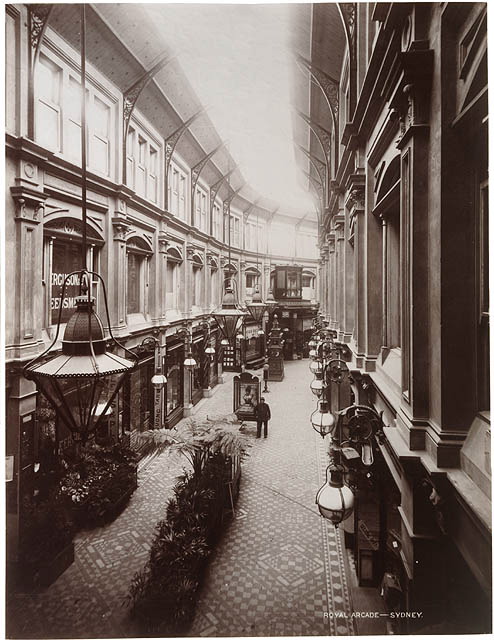
Luca Antara, the book, tarries a while in the QVB, because, when I first came to Sydney, that's where the Public Library was. I was interested in telling a brief version of its history but as I was in New Zealand when I wrote that section, I got my material on-line. Now, preparing the Notes on Sources, I find that there is a book about the Grand Dame. The Queen Victoria Building 1898-1986, by John Shaw with photos by David Moore (among others), was written at the initiative of architects Stephenson & Turner, who carried out the restoration of the building in the 1980s. Lovely book. One of its glories is the archival photographs, which are not restricted to the building itself but cover many aspects of Sydney's CBD down the years. I was fascinated by the pictures of arcades, most of which were demolished before I came here. The Imperial Arcade, which resembled a theatre set; the Victoria Arcade, with its elliptical glass dome; the Royal Arcade with its Roman and Florentine echoes. Only the Strand Arcade now remains, along with the QVB itself which, although it is a free standing building, has many affinities with arcade buildings, for example, its glazed barrel vault roof.

I can't remember now where we'd been - perhaps to a concert or a gig - I do recall one night, late, wandering with my then wife into the newly restored QVB, which was wide open, brightly lit and vastly empty; this was before the shops had been tenanted or opened. There was distant music coming from the upper levels. We walked into each other's arms and waltzed together along the tiled floor of the promenade known as the Avenue. This floor slopes, there's a slight hill running down Market Street towards George Street, probably the old bank of the Tank Stream, and the makers of the building followed that fall. I'm no longer sure either if it was the same night or another - probably the same - that, climbing the stairs we found, on the top-most level, a function or celebration of some kind going on. Passing across the floor we encountered Barry Humphries, so shickered he could not stand up, being escorted, like an ocean liner by tugboats, by two gorgeous young women from one revelry to another. Or perhaps from revelry to bathroom.
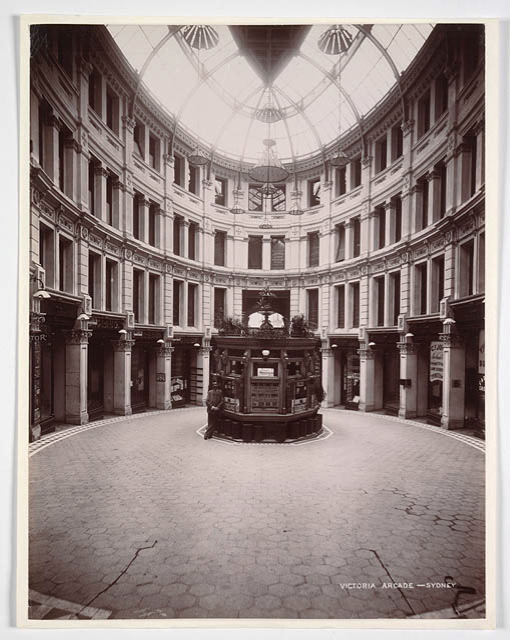
After finishing the book I went and had another look at the QVB, and at the Strand Arcade. Beautiful structures, beautifully restored (Stephenson & Turner did the Strand as well), yet I couldn't help feeling a slight pang of disappointment. Why? I think it's just the dullness of the use they are put to, at least from my point of view. I can remember being absolutely fascinated by the arcades in Auckland in the 1970s, because of the strange variety of shops, businesses and other organisations you found there: erotica, philately, obscure foreign friendship societies, fortune tellers, dance academies and who knows what else. Whereas now what you find is the relentless shininess of contemporary consumer culture. Many wonderful things are there which you can buy if you want, but something else is lacking, perhaps aura, perhaps grime, perhaps a whiff of the disreputable. The QVB replaced the George Street Markets and was built as a market itself. In its early days it attracted palmists and mind-readers along with teachers of music, art and dance. Now mostly what you find are handbags, hand lotions, hand made chocolates. It'd be an awful confession to say that I preferred the QVB derelict and that isn't quite what I mean. I just wish there was less shininess, more texture, some fluid and chaotic tactility there.
Monday, March 13, 2006
RuneScape
Had a good time with my kids this weekend. Or, should I say, they had a good time with me? Partly it was because Jesse's friend Monty came over Saturday night for a sleepover. Kids like being in a pack, even three is better than two. At one point we went over to the local park for an hour or so. It was early evening; tennis on the courts, skate-boarders and bike riders on the skate-board rink, smaller kids on the equipment and the littlies in the fenced off playground; a soccer game featuring, I noticed, two of the guys from the local liquor shop. At one point Liamh, who's obsessed with them, found a stash of sticks behind a tree on the far edge of the park and enlisted the other two in a game. I watched it from a bench on the other side, far too far away to hear anything or see detail. They were big, robust looking sticks, thick and long; but the boys seemed to be using them not as weapons but as ... I don't know? Wands? Their movements had an hieratic quality, they held them gesturally and moved them slowly through the air. It looked like a dance and went on for quite a while, quarter of an hour maybe. Then, all of a sudden, they laid them down (behind another tree, for later perhaps) and came tearing back across the park towards me. As we were walking home I asked what they'd been doing. Orrh, said Jesse, We were playing Runescape. He didn't expatiate and I didn't ask. Runescape's huge among the kids and it seems like a different sort of game from the usual shoot 'em up, bang 'em down. My boys don't play it here much because it requires a PC for its full range to be available and I'm on a Mac; when they do I'm impressed by the contemplative air that comes over the flat. One day this weekend I watched them build a canoe and sail it down a river. Another time, I recall Jesse telling me he knew how to fletch arrows. He described the process in great detail and then allowed that, yes, they were virtual arrows. This is a game where groups form and play against/with each other; some of these groups are very large and, it goes without saying, they are multinational. I'm intrigued ... but not as intrigued as I was by the stick game I saw across the park the other evening.
Friday, March 10, 2006
Once on Chunuk Bair
Am I getting sentimental in my old age? The other morning, just after I woke up, I felt the need to check some geographical details with respect to the Gallipoli peninsular. I was trying to understand the precise relationship between Lone Pine, Chunuk Bair and the Nek. Also, which were the troops that took the first, and the second, though only briefly, and were slaughtered in their hundreds at the third site. Was it simply the sound of the names in my head, on my tongue, that blurred my eyes, so that I could not read the words on the page? It was strange to lie back on the pillows and feel the tears running down my cheeks - why?
Sunday, March 05, 2006
badman
As anyone who has ventured there knows, Ern Malley Alley is a hall of mirrors, an infinite regression, a world of answers without questions and questions lacking answers. You go there at your peril and if you will be so bold or so foolish, you need allies: a sense of humour, an unimpaired sceptical sense, what Keats called negative capability ... anyway. Something I hadn't quite considered when I entered the labyrinth was that I would be dealing with my father's generation, obvious as that might seem. He was born in 1920, the second of three brothers. Ern Malley was born in 1918, the 14th of March, Einstein's birthday; James McAuley in 1917, Harold Stewart in 1916 ...
Another thing I did not anticipate is that I would find myself wrangling with the ghost of Don Bradman (b. 1908). How did this happen? Well, partly it's simply local history: the boy from Bowral made his first century in Sydney grade cricket just down the road from here, at Petersham Oval (there's a plaque), which means it's at least possible that Ern, who grew up in the area, was there that November day. Partly, too, it's because if you read Australian history between the wars, you simply can't escape the Don. He is ubiquitous. So that, a few weeks ago, I went to the Ashfield library and brought home a couple of books, one of which, written by an Englishman as social history as well as sporting biography, was so good that I read it cover to cover in a matter of days. Now, coincidentally, I've just watched the second instalment of a two part television documentary on ABC, which covers the same ground as the book and even interviews its author. So what have I learned?
Well, it's an emotional minefield. And very personal. My father loved two sports, rugby and cricket. He'd played both, with some skill, in his youth, coached school teams while he was teaching, later on spent a lot of time listening to games on the radio or watching them on television. I inherited these enthusiasms from him and maintained them during his long decline partly so as to have this neutral common ground where we could always go when we talked. Now he's gone I don't know why I keep them up because the actual sporting culture as it has evolved, mostly disgusts me. That's one thing. The second thing is the intimate relationship between Australian life and sporting prowess. Much has been made of the fact that Bradman's prodigious feats as a batsman began during the Great Depression and that for many people living in penury and misery, he became a kind of secular saviour ... this strange contract, between sporting success and the pride of individuals in themselves, is not confined to Australians but they - we - are certainly paragons in its expression. As an expat New Zealander who is an Australian citizen, I express this fanaticism in reverse, taking no pleasure in Australian wins and great delight in their unfortunately rare losses. Weird, huh?
But, Bradman. The great hero of the common man, and a common man himself ... except he wasn't. He was a protestant in a land of Irish Catholics, a teetotaller in a country of drinkers and drunks, he played the piano and listened to classical music, in the evenings after a day's play, instead of celebrating with his mates, he'd go to his room and write letters or read books. And get an early night. He was also a Royalist in a culture that at least fancies itself to be 'naturally' Republican, he earned his living as a stock broker and wasn't above taking financial advantage of circumstances when he could see a way to do so - when, in 1945, his boss in Adelaide informed the Stock Exchange he could no longer meet his commitments, Bradman had taken over the office and hung his shingle out within 36 hours of the declaration, apparently with the consent of the receiver. In some of this, he shows a character not unlike that of my paternal grandfather, who was all of those things: protestant, teetotal, royalist, businessman, devious, a sporting fanatic - and Australian; most of this description also fits the present Australian Prime Minister, John Howard (I don't believe he is teetotal). The other thing the three men - Bradman, my grandfather, Little Johnny - have in common is their ruthlessness.
As we know, sport is a surrogate for war and despite all the waffle about playing the game, you can't really engage in it without a determination to win. Afterwards you may fraternise with your opponents but while the game's on you have to be prepared almost to kill. In our peculiar culture, that analogy with war does extend to business and to politics, but with this difference: the wins and losses are real, there are real victims, real casualties, real deaths. Bradman's extreme ruthlessness as a cricketer, later as Australian captain, was mostly visited upon the English, whom he took great delight in humiliating howsoever and whenever he could; but there was no contradiction with his Royalism or his Empire Loyalism, because it was just a game. For precisely the same reason, sport/war is a very bad analogy for business and politics, but pervasive nevertheless. Watching Little Johnny bask in the approbation of the local version of the great and the good during his ten year anniversary celebrations made me realise that he has a conscience white as the driven snow, as they say, most likely because he's left all that behind on the playing field. Watching the obsequies for Kerry Packer, that superlative sporting man, the other week led to the same conclusion. For these kinds of people, the end does justify the means and the end is, in the end, very simple: to win.
My father set himself against his father and attempted to live an ethical life; it ended in alcoholism, loneliness and despair, with one of his few consolations, the rugby or the cricket on the TV or the radio. This doesn’t mean that he made the wrong choice and nor is it sufficient to ascribe his fate to that choice: of course not, there were a lot of other factors involved, which I can’t go into here. But it was a conscious choice: the poetry he wrote in his youth he abandoned in order to dedicate himself to a form of social action which would make a real difference to peoples’ lives and in this he was remarkably successful; the visits he sometimes got from those he had taught were another of his consolations.
Ern Malley didn’t have to live with the consequences of his dedication to poetry, though both James McAuley and Harold Stewart did. Sometimes I imagine Malley as a kind of Anti-Bradman, feckless where the other was conscientious, ironic rather than sincere, profligate not abstemious, raucous not calm, unsporting, twisted, decadent, sardonic, rude … but of course he wasn’t an Anti-Bradman so much as an Anti-Everything: everything, that is, that could not be fitted into the world view of two gifted yet resentful men, both self-hating, one of whom became a Catholic conservative academic, the other a scholarly Buddhist monk. As for Bradman, he lived to a ripe old age and was, so far as one can tell, kind to his old opponents - but never forgave his enemies. I understand John Howard is a great hater too.
Another thing I did not anticipate is that I would find myself wrangling with the ghost of Don Bradman (b. 1908). How did this happen? Well, partly it's simply local history: the boy from Bowral made his first century in Sydney grade cricket just down the road from here, at Petersham Oval (there's a plaque), which means it's at least possible that Ern, who grew up in the area, was there that November day. Partly, too, it's because if you read Australian history between the wars, you simply can't escape the Don. He is ubiquitous. So that, a few weeks ago, I went to the Ashfield library and brought home a couple of books, one of which, written by an Englishman as social history as well as sporting biography, was so good that I read it cover to cover in a matter of days. Now, coincidentally, I've just watched the second instalment of a two part television documentary on ABC, which covers the same ground as the book and even interviews its author. So what have I learned?
Well, it's an emotional minefield. And very personal. My father loved two sports, rugby and cricket. He'd played both, with some skill, in his youth, coached school teams while he was teaching, later on spent a lot of time listening to games on the radio or watching them on television. I inherited these enthusiasms from him and maintained them during his long decline partly so as to have this neutral common ground where we could always go when we talked. Now he's gone I don't know why I keep them up because the actual sporting culture as it has evolved, mostly disgusts me. That's one thing. The second thing is the intimate relationship between Australian life and sporting prowess. Much has been made of the fact that Bradman's prodigious feats as a batsman began during the Great Depression and that for many people living in penury and misery, he became a kind of secular saviour ... this strange contract, between sporting success and the pride of individuals in themselves, is not confined to Australians but they - we - are certainly paragons in its expression. As an expat New Zealander who is an Australian citizen, I express this fanaticism in reverse, taking no pleasure in Australian wins and great delight in their unfortunately rare losses. Weird, huh?
But, Bradman. The great hero of the common man, and a common man himself ... except he wasn't. He was a protestant in a land of Irish Catholics, a teetotaller in a country of drinkers and drunks, he played the piano and listened to classical music, in the evenings after a day's play, instead of celebrating with his mates, he'd go to his room and write letters or read books. And get an early night. He was also a Royalist in a culture that at least fancies itself to be 'naturally' Republican, he earned his living as a stock broker and wasn't above taking financial advantage of circumstances when he could see a way to do so - when, in 1945, his boss in Adelaide informed the Stock Exchange he could no longer meet his commitments, Bradman had taken over the office and hung his shingle out within 36 hours of the declaration, apparently with the consent of the receiver. In some of this, he shows a character not unlike that of my paternal grandfather, who was all of those things: protestant, teetotal, royalist, businessman, devious, a sporting fanatic - and Australian; most of this description also fits the present Australian Prime Minister, John Howard (I don't believe he is teetotal). The other thing the three men - Bradman, my grandfather, Little Johnny - have in common is their ruthlessness.
As we know, sport is a surrogate for war and despite all the waffle about playing the game, you can't really engage in it without a determination to win. Afterwards you may fraternise with your opponents but while the game's on you have to be prepared almost to kill. In our peculiar culture, that analogy with war does extend to business and to politics, but with this difference: the wins and losses are real, there are real victims, real casualties, real deaths. Bradman's extreme ruthlessness as a cricketer, later as Australian captain, was mostly visited upon the English, whom he took great delight in humiliating howsoever and whenever he could; but there was no contradiction with his Royalism or his Empire Loyalism, because it was just a game. For precisely the same reason, sport/war is a very bad analogy for business and politics, but pervasive nevertheless. Watching Little Johnny bask in the approbation of the local version of the great and the good during his ten year anniversary celebrations made me realise that he has a conscience white as the driven snow, as they say, most likely because he's left all that behind on the playing field. Watching the obsequies for Kerry Packer, that superlative sporting man, the other week led to the same conclusion. For these kinds of people, the end does justify the means and the end is, in the end, very simple: to win.
My father set himself against his father and attempted to live an ethical life; it ended in alcoholism, loneliness and despair, with one of his few consolations, the rugby or the cricket on the TV or the radio. This doesn’t mean that he made the wrong choice and nor is it sufficient to ascribe his fate to that choice: of course not, there were a lot of other factors involved, which I can’t go into here. But it was a conscious choice: the poetry he wrote in his youth he abandoned in order to dedicate himself to a form of social action which would make a real difference to peoples’ lives and in this he was remarkably successful; the visits he sometimes got from those he had taught were another of his consolations.
Ern Malley didn’t have to live with the consequences of his dedication to poetry, though both James McAuley and Harold Stewart did. Sometimes I imagine Malley as a kind of Anti-Bradman, feckless where the other was conscientious, ironic rather than sincere, profligate not abstemious, raucous not calm, unsporting, twisted, decadent, sardonic, rude … but of course he wasn’t an Anti-Bradman so much as an Anti-Everything: everything, that is, that could not be fitted into the world view of two gifted yet resentful men, both self-hating, one of whom became a Catholic conservative academic, the other a scholarly Buddhist monk. As for Bradman, he lived to a ripe old age and was, so far as one can tell, kind to his old opponents - but never forgave his enemies. I understand John Howard is a great hater too.
Wednesday, March 01, 2006
Houses of the Poets
It's never quite clear to me what is to be gained by going to look at houses where known people were born, grew up or at some stage lived, which doesn't mean I don't sometimes do it. At the very least, I suppose, there is subsequently a memory trace where before was either a blank or something imaginary. Which isn't to say the imaginary isn't preferable, only that it will in most cases recede before the real. Anyway ... having learned from Michael Ackland's book Damaged Men the addresses of the houses where James McAuley and Harold Stewart grew up, and realised they are both within a few kilometres of here, I went today to look at them.
52 The Crescent, Homebush, McAuley's home from the mid 1920s until he left home during WW2, is a small brick Victorian villa in a now leafy street running parallel to the main western line just down the road from the Homebush shops. It's shabby and neglected now, it looks like it's rented out, but it was probably far more prepossessing and indeed, straight-laced, when it belonged to the McAuley family. Jim's Dad was a successful real estate agent which raises the question as to why he kept on living in this rather small house in this rather grim suburb with its stockyards and its abbatoir; on the other hand, according to Jim, he was a rather grim man.
Although McAuley remembered the scent of wisteria, there's now a small frangi pani tree outside the window of the bedroom next to the front door, which may have been his: At night he watched the dancing shadows created by the lights of passing trains on his bedroom walls and dreamed of unknown destinations, Ackland says. The most startling presence in the street is an enormous Gallipoli Pine growing behind the house, one of the largest I have seen. McAuley, born in Lakemba in 1917, may have come into the world contemporaneous with this tree and I took its sombre presence as a sign that he still haunts the neighbourhood.
Chowringhee, where Harold Stewart was born in 1916 and where he grew up, is or was at 31 Tavistock Street, Drummoyne: a short, also leafy street, running up hill from Drummoyne Park with its green oval, not far from Five Dock Bay. All three streets crossing Tavistock are now major traffic arteries so the area does not have the quiet gentility it did when Harold lived here. His father, who was in India until his early thirties and spoke fluent Hindustani, was the local health officer.
The house at #31 presented the same drab exterior as did the McAuley residence, though it was clearly a much larger place. However, it seems to have been divided at some point into a makeshift duplex; the name plate, if there ever was one, has disappeared and I did wonder, since the other half of the duplex was #33, if I had the right house. Perhaps the street had been renumbered at some point?
This is what Ackland describes: Tavistock Street was shaded by camphor laurels and small gardens set off the entrances to most of its serried brick houses. The drab exterior of the Stewarts’ home accorded ill with its exotic Indian name ... and its tastefully presented interior. A large rear veranda afforded easy access to a modest oasis of calm, with fernery, fish pond, vines and a spreading apple tree, while Marion (Harold's sister, younger than him by nine years) remembered home-life as characterised by ahimsa, or non-violence of thought and deed.
There was a bullish looking man in a large 4WD parked outside #31 with the talkback radio turned up loud in his cab and he gave me the leery eye when I turned the car around and parked across the road to get a decent look at the house, so I didn't hang around for long. Ackland also writes: ... in the 1920s the future poet could still wander along dusty, unmade roads lined with gumtrees and post-and-rail fences, reminiscent of country towns, and shimmering water was always close at hand.
In contradistinction to the grimness of McAuley's bedroom (ordered and impersonal, its furnishings kept to a minimum with a bed, dresser and bare walls), Harold's served as study, art studio and music room ... the bed, which doubled as a settee when friends called, had a deep blue coverlet shot through with muted gold thread and [the room] contained a large desk, ample library, music stand and gramophone, as well as a small table for displaying art works — making it the prototype of his successive dwellings.
The strongest impression I took away from both houses is perhaps paradoxical: they each in their different way reminded me of the house at 40 Dalmer Street in Croyden, Ern Malley's sister Ethel's house, where the imaginary poet spent his last few imaginary months. This house was, as they say in fact, owned by Harold's sister, the aforementioned Marion ... the other thing I glimpsed, though only in passing, was the uniformity of these lower middle class western Sydney suburbs between the wars, with their rows and rows of near identical houses made of liver coloured brick, their pubs and corner shops, their bare streets where the trees, if they had even yet been planted, had scarcely begun to grow.
52 The Crescent, Homebush, McAuley's home from the mid 1920s until he left home during WW2, is a small brick Victorian villa in a now leafy street running parallel to the main western line just down the road from the Homebush shops. It's shabby and neglected now, it looks like it's rented out, but it was probably far more prepossessing and indeed, straight-laced, when it belonged to the McAuley family. Jim's Dad was a successful real estate agent which raises the question as to why he kept on living in this rather small house in this rather grim suburb with its stockyards and its abbatoir; on the other hand, according to Jim, he was a rather grim man.
Although McAuley remembered the scent of wisteria, there's now a small frangi pani tree outside the window of the bedroom next to the front door, which may have been his: At night he watched the dancing shadows created by the lights of passing trains on his bedroom walls and dreamed of unknown destinations, Ackland says. The most startling presence in the street is an enormous Gallipoli Pine growing behind the house, one of the largest I have seen. McAuley, born in Lakemba in 1917, may have come into the world contemporaneous with this tree and I took its sombre presence as a sign that he still haunts the neighbourhood.
Chowringhee, where Harold Stewart was born in 1916 and where he grew up, is or was at 31 Tavistock Street, Drummoyne: a short, also leafy street, running up hill from Drummoyne Park with its green oval, not far from Five Dock Bay. All three streets crossing Tavistock are now major traffic arteries so the area does not have the quiet gentility it did when Harold lived here. His father, who was in India until his early thirties and spoke fluent Hindustani, was the local health officer.
The house at #31 presented the same drab exterior as did the McAuley residence, though it was clearly a much larger place. However, it seems to have been divided at some point into a makeshift duplex; the name plate, if there ever was one, has disappeared and I did wonder, since the other half of the duplex was #33, if I had the right house. Perhaps the street had been renumbered at some point?
This is what Ackland describes: Tavistock Street was shaded by camphor laurels and small gardens set off the entrances to most of its serried brick houses. The drab exterior of the Stewarts’ home accorded ill with its exotic Indian name ... and its tastefully presented interior. A large rear veranda afforded easy access to a modest oasis of calm, with fernery, fish pond, vines and a spreading apple tree, while Marion (Harold's sister, younger than him by nine years) remembered home-life as characterised by ahimsa, or non-violence of thought and deed.
There was a bullish looking man in a large 4WD parked outside #31 with the talkback radio turned up loud in his cab and he gave me the leery eye when I turned the car around and parked across the road to get a decent look at the house, so I didn't hang around for long. Ackland also writes: ... in the 1920s the future poet could still wander along dusty, unmade roads lined with gumtrees and post-and-rail fences, reminiscent of country towns, and shimmering water was always close at hand.
In contradistinction to the grimness of McAuley's bedroom (ordered and impersonal, its furnishings kept to a minimum with a bed, dresser and bare walls), Harold's served as study, art studio and music room ... the bed, which doubled as a settee when friends called, had a deep blue coverlet shot through with muted gold thread and [the room] contained a large desk, ample library, music stand and gramophone, as well as a small table for displaying art works — making it the prototype of his successive dwellings.
The strongest impression I took away from both houses is perhaps paradoxical: they each in their different way reminded me of the house at 40 Dalmer Street in Croyden, Ern Malley's sister Ethel's house, where the imaginary poet spent his last few imaginary months. This house was, as they say in fact, owned by Harold's sister, the aforementioned Marion ... the other thing I glimpsed, though only in passing, was the uniformity of these lower middle class western Sydney suburbs between the wars, with their rows and rows of near identical houses made of liver coloured brick, their pubs and corner shops, their bare streets where the trees, if they had even yet been planted, had scarcely begun to grow.
Sunday, February 26, 2006
This site is allegedly a year old today tho', not really, because the first few posts appeared on the sister site & were moved over here later ... b-but it is a year since I got my taxi licence (for the third time!) & thus time to renew it again. Because I'm not driving at the moment that can be done in a fairly leisurely manner, still costs about 500 bucks however, which I don't like paying, specially because I don't really ever want to drive a cab again ... on the other hand, common sense tells me that, things being as they are, precarious, I can't really afford not to (renew my licence I mean). Will probably run out of money not long after this financial year ends (June 30) &, unless something else comes along, how else am I going to make the rent? pay for the kids? feed my habit(s)? ... ah, yes, sometimes I really do wonder how much of this money anxiety I feel is constitutional, how much circumstantial? Would I still feel insecure on 500 grand a year? Some of my happiest times have been when I've had nothing blah blah blah ...
Sunday, February 19, 2006
QE2
Last week two nights in a row, at the same hour, I went to the Dendy Cinema at Circular Quay to see a film. The first, the premier of a short I'd been invited to because I'd been speaking with the producer about another matter; the second, the opening of the IndiVision Screenings for this year - I was a participant in the IndiVision Lab last year. Neither film was quite satisfactory but that's not what I'm here to say.
I always prefer being early to the movies so I caught the train about 5.15 and was at the Quay by 5.45 for a 6.15 screening. There I was, ambling along, in no hurry, intending to stop in at an art shop where you can reliably see lithos by the likes of Chagall and Miro and Dali and Bonnard, when I look up and see this:
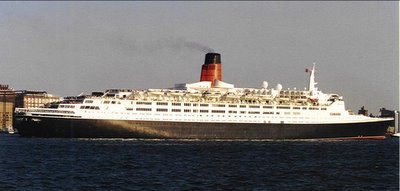
She was moored in West Circular Quay and took up the whole length of harbour on that side, seeming as long if not longer than the bridge, which kind of grew out of her bow. A few lights on, a few idle figures lounging on her decks taking the evening air - they were all David Niven types in white cravats to me, smoking Sobranes - while hanging below her funnel, bizarrely, was a hand written banner saying DO NOT APPROACH CLOSER THAN FIFTY METRES. For terrorists, I guess.
Big old ocean liners always make me think of Fellini's Amarcord, the night scene where the characters row or wade out into the water to see one passing by, like a space ship from some wonderful, perhaps alien civilization whose planet you might one day be lucky enough to visit.
Thursday was hot and then about four the thunderheads rolled in, with a spattering of big fat drops which, by the time I went to catch the train, had turned to steady though not hard rain. The train must have travelled with the cloud because it was raining as well in the City, which had been clear when I left - I can see it from my balcony. I don't mind getting a bit wet, I was enjoying it and anyway, there's a covered walkway from the Quay to the Toaster and the Opera House and the QE2 was still there, looking more like this:
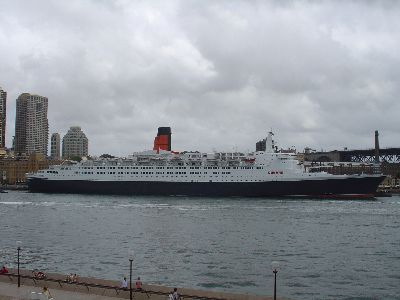
though rather more beautiful in the after storm light. I knew by now that she was departing for Melbourne that night and could already see a thin thread of diesel smoke drifting from her funnel. I was hoping that after the movie was over we might be lucky enough to see her steam out - that would have been something. The film, from Israel, was an inconsequential tale about a unit of girl soldiers patrolling Jerusalem which somehow managed to be trivial and claustrophobic at the same time and, instead of ending, just stopped. The last shot was interminable, two girls on one motorcycle riding through the city with, for some reason I will never know, the word KIWI written on each of their helmets.
It was dark by now, we stood around in a roped off enclosure in a bar area under the Opera House as canapes and wine waiters circled and networks got worked. I was with a director friend and she was with an actor friend and none of us could raise much enthusiasm for working the nets so, just as they served trays of boxed stir-fried beef noodles, we left and ate leaning over the rails looking at that fabulous apparition which, while it was smoking more than it had been, did not look like leaving before we ourselves wandered off into the night.
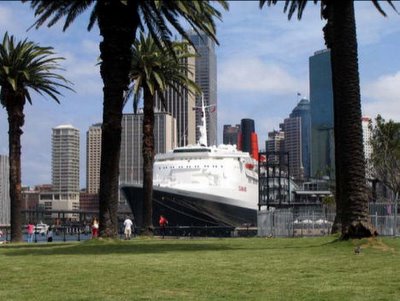
So she's gone now but, if I'd got around to the other side of the Quay in daylight, I might have seen something like this:
I always prefer being early to the movies so I caught the train about 5.15 and was at the Quay by 5.45 for a 6.15 screening. There I was, ambling along, in no hurry, intending to stop in at an art shop where you can reliably see lithos by the likes of Chagall and Miro and Dali and Bonnard, when I look up and see this:

She was moored in West Circular Quay and took up the whole length of harbour on that side, seeming as long if not longer than the bridge, which kind of grew out of her bow. A few lights on, a few idle figures lounging on her decks taking the evening air - they were all David Niven types in white cravats to me, smoking Sobranes - while hanging below her funnel, bizarrely, was a hand written banner saying DO NOT APPROACH CLOSER THAN FIFTY METRES. For terrorists, I guess.
Big old ocean liners always make me think of Fellini's Amarcord, the night scene where the characters row or wade out into the water to see one passing by, like a space ship from some wonderful, perhaps alien civilization whose planet you might one day be lucky enough to visit.
Thursday was hot and then about four the thunderheads rolled in, with a spattering of big fat drops which, by the time I went to catch the train, had turned to steady though not hard rain. The train must have travelled with the cloud because it was raining as well in the City, which had been clear when I left - I can see it from my balcony. I don't mind getting a bit wet, I was enjoying it and anyway, there's a covered walkway from the Quay to the Toaster and the Opera House and the QE2 was still there, looking more like this:

though rather more beautiful in the after storm light. I knew by now that she was departing for Melbourne that night and could already see a thin thread of diesel smoke drifting from her funnel. I was hoping that after the movie was over we might be lucky enough to see her steam out - that would have been something. The film, from Israel, was an inconsequential tale about a unit of girl soldiers patrolling Jerusalem which somehow managed to be trivial and claustrophobic at the same time and, instead of ending, just stopped. The last shot was interminable, two girls on one motorcycle riding through the city with, for some reason I will never know, the word KIWI written on each of their helmets.
It was dark by now, we stood around in a roped off enclosure in a bar area under the Opera House as canapes and wine waiters circled and networks got worked. I was with a director friend and she was with an actor friend and none of us could raise much enthusiasm for working the nets so, just as they served trays of boxed stir-fried beef noodles, we left and ate leaning over the rails looking at that fabulous apparition which, while it was smoking more than it had been, did not look like leaving before we ourselves wandered off into the night.
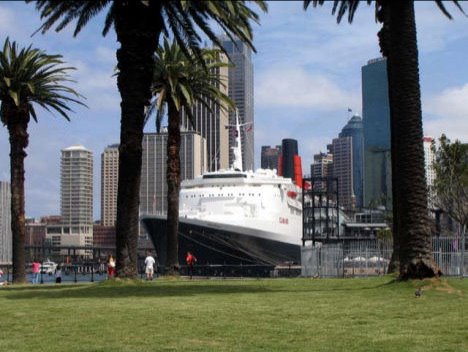
So she's gone now but, if I'd got around to the other side of the Quay in daylight, I might have seen something like this:
Tuesday, February 07, 2006
Rowe Street

For a big city, a world city as it likes to think itself, Sydney does not have a very good Public Library. This probably reflects the way the municipality is divided up, the Sydney City Council has jurisdiction only over the CBD proper, the adjoining inner city suburbs are administered by other councils; most of the suburban libraries are rather better, if not bigger, than the Central one. I haven't bothered rejoining since I came back here to live a year ago and in fact didn't even know where it was any more, until yesterday.
I was going to see an exhibition called Memory Lane : Recollecting Rowe Street. Rowe Street was a short narrow street running between Castlereagh and Pitt Streets, just south of Martin Place in the City. It was like an Arcade without a roof and featured shops you didn't find in other parts of town. At one end was the grand Australia Hotel, at the other, the Millions Club (dedicated to population growth); in between you could (in the 1950s and 60s) buy chic hats and dresses, espresso, avant-garde pictures, banned books and modern furnishings. It had been that way, a little piece of Bohemia, at least since the start of the 20th century, when the former literary editor of the Bulletin, A. G. Stephens, and artists Lionel Lindsay and Antonio Datillo-Rubbo rented garret studios on the street.
The exhibition, on the first floor at the recently restored Customs House at Circular Quay, didn't amount to much : three glass cases of displays of wares from those chic and arty shops plus a dozen or so photographs made over into large wall panels. Interesting enough but it wasn't quite what I was expecting. The New Customs House is open plan and there was a lot of conspicuously leisurely lounging around going on, which I found distracting I guess. Never mind.
It was as I was leaving that wing where the exhibition was that I saw a high tech, bright red counter at one end of the floor and realised it was a library I was in ... the Sydney Public Library, made over to look as much as possible like a bookshop - one with hardly any books it it. Fiction A - L seemed all that there was; and the copy of The Situationist City lying casually on a table nearby was asking to be - not stolen, picked up and taken away. I resisted that particular temptation and went up to the next floor to explore, looking for the rest of the books.
They were there, on Floor Two, and seemed somewhat rehabilitated from the sad and tatty collection that used to be housed in an office building behind the Town Hall, and before that in a room in the otherwise derelict Queen Victoria Building. I inquired about re-joining and was relieved to learn my name was no longer on the database - there had been some anomalies in my borrowing behaviour in earlier years - but startled to learn that there is now a joining fee of $11.50. The help was either ignorant or terminally rude, I couldn't decide which. Well, I will join, I guess, sometime ...
Getting back to Rowe Street, most of it was demolished in the early 1970s to make way for the MLC Centre, about which the less said, probably the better. The bit they didn't destroy still exists, a numb and bland service lane running behind the Commonwealth Bank Building to the back of the MLC and the Theatre Royal. I did like the epigraph for the show, from Baudelaire : The form of a city changes more quickly, alas, than the heart of a mortal.
Subscribe to:
Posts (Atom)